The Indus Treaty Is Dead. Pakistan’s Water Crisis Has Just Begun
- June 22, 2026
- Posted by: admin
- Categories: India, Pakistan
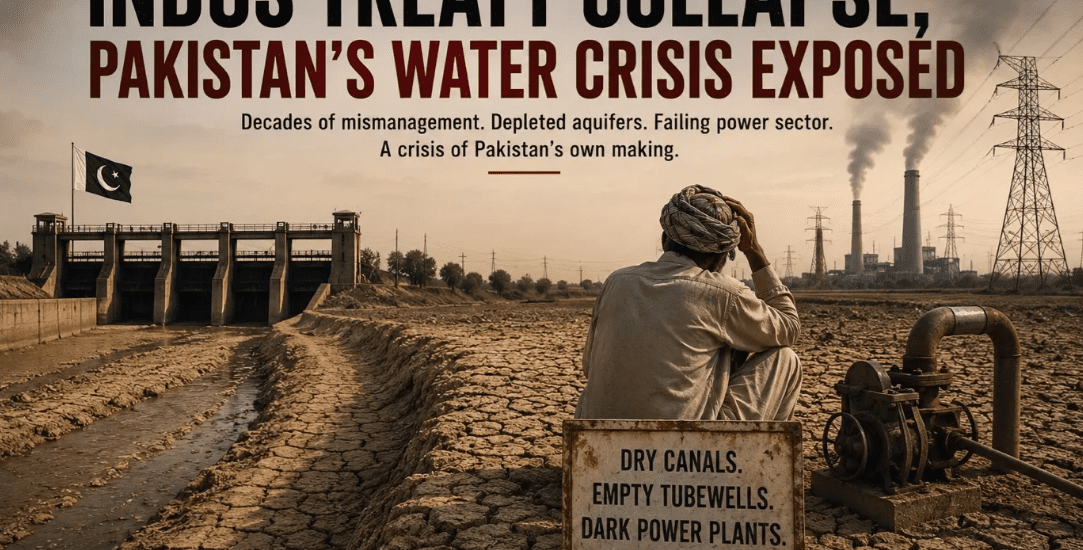
India’s suspension of the treaty has exposed the deeper collapse of Pakistan’s irrigation and power infrastructure.
AKHIL BAKSHI
For sixty-five years, the Indus Waters Treaty survived wars, military coups, terrorism, diplomatic breakdowns, and the perpetual hostility between India and Pakistan. It was perhaps the only agreement between the two countries that actually functioned with mechanical regularity. India honoured it even after the 1965 war, the 1971 war, the Kargil conflict, and the Mumbai terror attacks.
AKHIL’s Substack is a reader-supported publication. To receive new posts and support my work, consider becoming a free or paid subscriber.Subscribe
Then, in April 2025, India suspended the treaty following another major deterioration in bilateral relations. Pakistan rushed to international forums. A Court of Arbitration declared India’s suspension illegal. India rejected the court’s authority altogether. The old framework of predictability collapsed overnight.
But from an Indian perspective, the deeper reality is this: Pakistan’s water crisis did not begin with India. India merely exposed a disaster Pakistan had spent decades carefully ignoring.
Pakistan today operates one of the world’s largest irrigation systems — a sprawling colonial-era hydraulic empire of reservoirs, barrages, and nearly 60,000 kilometres of canals. Ninety percent of the country’s food production depends upon it. The system was designed in the 1960s for a population of around 70 million people. Pakistan’s population now exceeds 240 million.
The arithmetic no longer works.
Per capita water availability has crashed from over 5,000 cubic meters annually to roughly 1,000 — the internationally accepted threshold of water scarcity. Reservoir sedimentation has wiped out nearly a third of storage capacity. The country possesses barely 30 days of live water storage. A single failed monsoon or prolonged river disruption now threatens national stability.
And yet, Pakistan continues to behave like a water-rich country.
The real scandal is not merely scarcity. It is mismanagement on an epic scale.
In Punjab and Sindh, politically influential landlords continue cultivating water-intensive crops such as rice and sugarcane in semi-arid regions where nature never intended them to grow. Procurement subsidies and political patronage encourage agricultural choices completely divorced from hydrological reality.
The inequality within Pakistan’s irrigation economy is astonishing.
A politically connected farmer near the head of a canal receives reliable water at heavily subsidised rates. A small tail-end farmer in southern Punjab may receive canal water only once every two weeks — if at all. He survives by pumping groundwater using diesel-powered tube wells at ruinous cost.
For wheat cultivation alone, the tail-end farmer may spend Rs 15,000 per acre on diesel irrigation during a season, while his wealthier upstream counterpart pays barely a few hundred rupees annually in government water charges.
Same province. Same river. Same crop.
But the poor pay exponentially more for water than the powerful.
The consequences are now visible beneath the surface.
Pakistan has drilled more than a million private tube wells. Groundwater now supplies over half the irrigation needs of Punjab. Aquifers are collapsing. Water tables in central Punjab are falling rapidly. In Sindh, saline intrusion is poisoning freshwater reserves.
Yet groundwater extraction remains virtually unregulated.
There is no serious metering system. No effective licensing regime. No meaningful pricing structure linked to depletion. Incredibly, provincial governments continue subsidising solar-powered pumps, making extraction even cheaper and accelerating aquifer exhaustion.
The institutional paralysis is equally alarming.
The Indus River System Authority allocates river flows but exercises no control over agricultural efficiency. Water and Power Development Authority (WAPDA) builds dams but has little authority over groundwater governance. Provincial irrigation departments distribute canal water with minimal transparency and weak financial accountability.
Pakistan does not suffer from a shortage of laws. It suffers from a shortage of enforcement.
Water Acts passed in Punjab and Khyber Pakhtunkhwa remain largely ornamental documents gathering bureaucratic dust.
Meanwhile, another crisis quietly compounds the disaster: Pakistan’s power sector.
The country’s irrigation system increasingly depends on energy-intensive groundwater pumping. As canal reliability declines, farmers turn to diesel engines and electric tube wells. But Pakistan’s power sector itself remains trapped in chronic dysfunction — circular debt, expensive imported fuel, transmission losses, power theft, and recurring blackouts.
The result is a vicious cycle.
Water scarcity drives greater dependence on pumping. Pumping increases electricity demand. Electricity shortages raise irrigation costs. Farmers then overexploit groundwater because unreliable canal supply leaves them little choice.
In rural Pakistan today, the water crisis and the energy crisis are no longer separate problems. They feed each other relentlessly.
Every additional unit of groundwater extracted requires energy Pakistan increasingly cannot afford.
India’s suspension of the Indus treaty has therefore arrived at the worst possible moment for Pakistan.
The suspension itself does not create Pakistan’s internal failures. But it removes the strategic certainty Islamabad once relied upon. For decades, Pakistani planners assumed that treaty-guaranteed river flows would continue regardless of political tensions. That assumption has now evaporated.
India, for its part, is accelerating infrastructure projects such as the Shahpur Kandi barrage to maximise utilisation of waters allocated under the treaty framework. Data-sharing arrangements have weakened. Water, once insulated from geopolitics, is increasingly becoming part of geopolitical signalling.
From New Delhi’s perspective, Pakistan’s appeals to international sympathy ring somewhat hollow. India cannot indefinitely subsidise a neighbouring state’s incompetence while simultaneously enduring terrorism, hostility, and diplomatic aggression.
The uncomfortable truth is that Pakistan’s water catastrophe is largely self-inflicted.
No treaty can save a country that refuses to price water rationally, regulate groundwater extraction, modernise irrigation, reform crop incentives, or repair its collapsing power infrastructure.
The Indus system is not dying because India turned off a tap.
It is dying because Pakistan spent decades pretending the tap was infinite.