Part I : From Doctrine to Decisive Action: Does India Have a New Way of War?
- September 30, 2026
- Posted by: admin
- Category: India
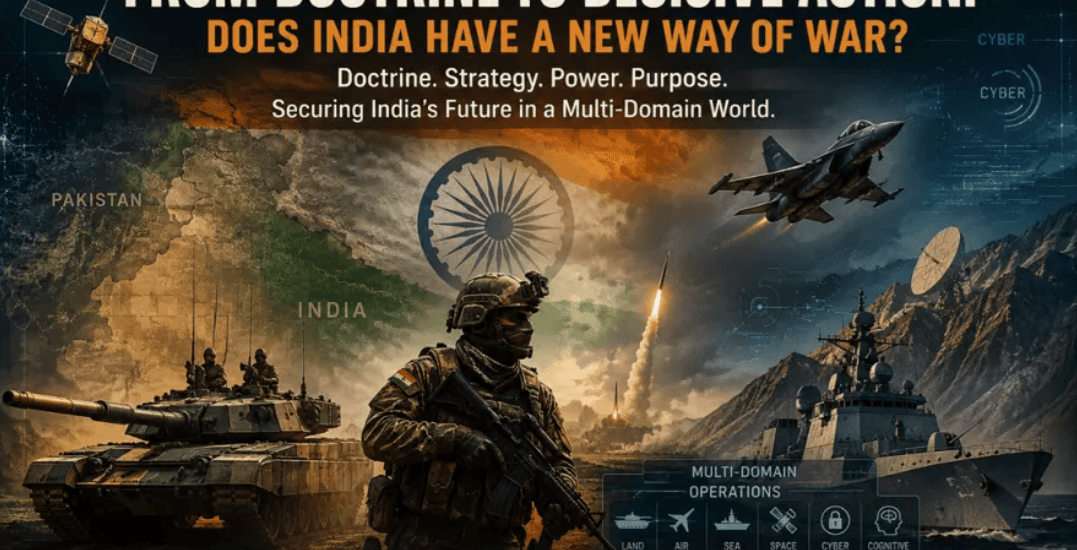
Understanding doctrine, strategy and the emerging Indian approach after Operation Sindoor
Introduction
Military terminology is often used loosely in public discourse. Words such as strategy, doctrine, posture, concept, policy and operational art are frequently treated as interchangeable, although they occupy distinctly different levels of the hierarchy of war. This distinction has acquired particular importance in India following Operation Sindoor and the subsequent public statements of National Security Adviser Ajit Doval and Lieutenant General Rajiv Ghai.
The question increasingly being asked is whether these statements amount to the emergence of an Indian “war doctrine”. The proposition is attractive. Operation Sindoor demonstrated characteristics that appeared different from India’s earlier responses to terrorism: political objectives were clearly articulated, military force was used beyond the traditional geographic limits associated with counter-terrorism, operations were calibrated, precision weapons and air power were integrated with intelligence and information capabilities, escalation was consciously managed, and military action was combined with diplomatic, economic and informational instruments.
Lieutenant General Rajiv Ghai subsequently described Operation Sindoor as a maturation of India’s approach “beyond the binaries of peace and war”. He also characterised the operation as a fusion of military precision, diplomatic agility, informational superiority and economic leverage.
Ajit Doval’s more recent articulation has been equally consequential. In August 2026, he disclosed that the political direction for Operation Sindoor was to “go after the terrorists wherever they are”, while stressing that India’s restraint should not be mistaken for weakness. These statements are strategically significant. But they do not, by themselves, constitute a war doctrine.
They are better understood as public articulation of elements of an evolving national security strategy and military-strategic posture, informed by the experience of Operation Sindoor. India already possesses military doctrines, including the Joint Doctrine Indian Armed Forces–2017 and, more recently, the Joint Doctrine for Multi-Domain Operations released in August 2025. The latter explicitly provides for coordinated employment of military and national capabilities across land, sea, air, space, cyber and cognitive domains.
The more interesting question, therefore, is not whether India suddenly acquired a doctrine through the statements of individual leaders. It is whether India is now evolving from a collection of service doctrines and operational concepts towards a more coherent national way of war. That distinction is fundamental.
What Exactly is a Military Doctrine?
Doctrine is, at its simplest, the accumulated professional judgement of a military establishment about how military power should be prepared, organised and employed. The Indian Joint Doctrine has described military doctrine as a “guide to action” rather than a set of rigid rules. It is authoritative but requires judgement in application. The same document makes an especially important distinction: doctrine is neither operations nor tactics, and its principal source is experience.
This is a useful definition because doctrine occupies the space between theory and practice. A military does not enter war afresh every time it is confronted by a crisis. It has already thought about the character of conflict, the likely adversary, the environment, the capabilities available, the organisation of forces and the principles by which those forces should be employed.
Doctrine converts that accumulated intellectual preparation into a common framework. It answers questions such as: What kind of war are we likely to fight? What are the characteristics of that war? What principles should guide the employment of military power? How should different arms and services operate together? What role should technology play? How should command and control be organised? How should information superiority be achieved? What degree of decentralisation is desirable? How should escalation be controlled?
Doctrine therefore provides a shared intellectual architecture for warfare. It is not a war plan. It is not a contingency plan. It is not an order to attack a particular country. It is not a political decision to go to war. And it is certainly not a collection of statements made at press conferences. The distinction matters because doctrine must survive changes in personalities, governments, commanders and individual operations.
Doctrine and Strategy: Related but Fundamentally Different
Strategy is the bridge between political objectives and the employment of national power. At the highest level, grand strategy determines how political, diplomatic, economic, technological, informational and military instruments are combined to secure national interests.
Military strategy translates those political objectives into military objectives and determines how military power will contribute to achieving them. Doctrine operates below strategy. A useful conceptual hierarchy is:
National interests → national policy → grand strategy → military strategy → doctrine → operational art → campaigns → battles → tactics.
The boundaries are not always rigid, but the hierarchy is intellectually useful. Strategy asks: What do we want to achieve, against whom, why and at what cost? Doctrine asks: Given the nature of war and our capabilities, what principles and methods should guide the employment of military power to achieve those objectives?
Operational art asks: How should a campaign be designed to translate strategic objectives into military outcomes? Tactics asks: How should individual engagements be fought?
This explains why a military can change its strategy without immediately rewriting all its doctrine, and why doctrine can influence strategy without itself being strategy.
Consider Operation Sindoor. The political decision to respond militarily to terrorism was a strategic decision. The selection of objectives and desired end-state constituted strategy. The decision to employ precision stand-off weapons, intelligence, surveillance and reconnaissance, air power, electronic warfare and integrated air defence represented operational and doctrinal choices. The actual sequencing of individual strikes and engagements belonged to operational planning and tactics. Calling the entire process “doctrine” therefore collapses several different levels of war into one word.
Why Does a Country Need Doctrine?
Doctrine is required because modern warfare is too complex to improvise. The battlefield contains thousands of interacting variables. Forces must operate under conditions of uncertainty, friction, incomplete information and time pressure. Communications may fail. Headquarters may lose contact with subordinate formations. Intelligence may be ambiguous. Political objectives may evolve. The adversary will attempt deception and disruption. Doctrine provides a common starting point.
The 2017 Indian Joint Doctrine specifically envisaged doctrine as a framework for joint planning and the conduct of operations across land, air, maritime, space and cyberspace. The Ministry of Defence described it as a cornerstone for applying military power in a synergised manner and as a reference for the three services in planning integrated operations. Doctrine therefore performs several functions simultaneously.
First, it establishes a common language. An Army commander, Air Force commander, naval commander, cyber operator and space operator must understand what “joint”, “integrated”, “effects”, “mission command”, “information superiority” and “multi-domain operations” mean in practical terms.
Second, doctrine shapes force structure. If the doctrine anticipates rapid, dispersed and highly networked warfare, the military requires different formations, communications architecture, sensors and logistics than an army preparing for a prolonged attritional war.
Third, doctrine drives training. The Indian Joint Training Doctrine of 2017 explicitly flowed from the Joint Doctrine and was intended to promote synergy and integration among the three services.
Fourth, doctrine informs procurement. A military does not merely buy weapons. It buys capabilities required to execute its preferred way of war.
Fifth, doctrine facilitates war planning. Commanders can begin planning from established principles instead of inventing the architecture of operations from scratch.
Sixth, doctrine creates institutional continuity. Commanders change. Governments change. Technology changes. Doctrine provides continuity while allowing adaptation.
The Indian military itself recognises that doctrines are evolving rather than immutable documents. The Joint Training Doctrine described doctrine as an “unfinished product” and an evolving body of distilled professional wisdom.
How Doctrine Facilitates War Planning
War planning begins long before war. The military studies potential adversaries, geography, force dispositions, vulnerabilities, logistics, intelligence requirements, mobilisation timelines, command arrangements and likely escalation pathways.
Doctrine gives these preparations a framework. Suppose a doctrine establishes that future conflict will be joint and multi-domain. Planners must then consider, from the beginning, not merely the Army’s manoeuvre plan but the relationship between land operations, air operations, maritime pressure, cyber operations, space-based surveillance, electronic warfare and information operations. This changes the very architecture of the plan.
The 2025 Joint Doctrine for Multi-Domain Operations is particularly significant in this regard. Released by Defence Minister Rajnath Singh in August 2025, it envisages integrated and synchronised employment across six domains: land, sea, air, space, cyber and cognitive. That is much more consequential than simply adding “cyber” and “space” to a conventional war plan.
It implies that military planners must seek convergent effects rather than merely coordinate separate service operations. The objective is no longer simply to destroy an enemy formation. It may be to create a simultaneous operational dilemma: blind the adversary’s sensors, disrupt command networks, degrade air defence, create information confusion, impose maritime pressure, attack selected physical targets and manoeuvre ground forces—all producing an effect greater than the sum of individual actions.That is the intellectual transition from joint operations to multi-domain operations.
Doctrine and War Prosecution
Doctrine becomes most valuable once war begins. A war plan can never survive contact with the enemy exactly as written. Clausewitz’s famous observation that “no campaign is conducted without friction” remains relevant because the enemy has a vote.
Doctrine provides the commander with principles when the plan breaks down. This is why doctrine must not become a rigid checklist. A commander who follows doctrine mechanically can lose a war. A commander who understands doctrine can adapt it to circumstances. This is the meaning behind the Indian formulation that doctrine is authoritative but requires judgement.
Doctrine therefore facilitates mission command. Higher headquarters establish intent, objectives and constraints while subordinate commanders exercise initiative within that framework. This becomes particularly important in a multi-domain battlespace where the speed of events may exceed the ability of higher headquarters to issue detailed instructions.
Artificial intelligence, autonomous systems, drones, cyber operations and long-range precision weapons are compressing decision cycles. The Indian MDO doctrine’s emphasis on integrated command, cross-domain coordination and decision superiority reflects this reality. Doctrine thus influences not merely what forces do but how commanders think. That may ultimately be its most important function.
Does India have a War Doctrine?
The short answer is yes—but not one single publicly declared “Indian War Doctrine” in the sense in which the term is sometimes used in public debate.
India has a hierarchy of doctrines. The Joint Doctrine Indian Armed Forces–2017 is the principal joint framework publicly available from the period. It establishes broad principles for military power and joint operations.
Since then, India has developed specialised doctrines. The 2025–26 doctrinal activity is particularly revealing. Official material lists doctrines and primers covering cyberspace operations, amphibious operations, integrated logistics, airborne and heliborne operations, special forces operations, multi-domain operations and military space.
The Joint Doctrine for Multi-Domain Operations, released in August 2025, is arguably the most important recent doctrinal development because it attempts to integrate the military instrument across six domains and extends the concept towards a whole-of-nation approach. India therefore does not suffer from an absence of doctrine. The larger issue is whether these individual doctrinal components have yet coalesced into a single, publicly articulated national way of war.That is a different question.
The Problem of “Cold Start”
The debate over India’s alleged Cold Start doctrine illustrates the difficulty of identifying doctrine. Following Operation Parakram in 2001–02, analysts argued that India was developing a new concept for rapid, limited conventional operations against Pakistan. It was popularly labelled “Cold Start”.
The concept envisaged faster mobilisation, integrated battle groups and limited offensive operations designed to impose costs without crossing Pakistan’s nuclear threshold. Yet the Indian government and senior military leaders repeatedly avoided officially accepting the term. General V.K. Singh famously stated that there was “nothing called Cold Start” and described India’s posture in terms of proactive options.This episode demonstrates an important principle: A doctrine does not become official merely because analysts give it a name. Nor does a doctrine cease to exist simply because officials refuse to use the label.Doctrine may exist at different levels of classification, institutional acceptance and public articulation. The same applies to contemporary claims that “Operation Sindoor doctrine” or “Modi doctrine” has emerged.
Why are Doctrines Sometimes Named After Individuals?
Military doctrines are occasionally named after commanders because those individuals played a formative role in developing or institutionalising the underlying concept. But this is not the norm.The “Sundarji Doctrine” is the classic Indian example. It is associated with General K. Sundarji and the restructuring of India’s conventional military posture, particularly the relationship between holding and strike formations. Academic literature describes the doctrine as being associated with India’s operational approach from roughly the 1980s into the early 2000s.
Naming a doctrine after an individual can serve several purposes. It can provide intellectual shorthand. It can identify the principal architect. It can distinguish one school of military thought from another. And, over time, it can become a historical label. But personal naming carries a danger. Doctrine is supposed to be institutional wisdom, not personal ideology. If a concept becomes excessively associated with one personality, it may acquire the character of a “commander’s doctrine” rather than a professional military doctrine.
The stronger the doctrine, therefore, the less dependent it should become on the personality who helped create it.
Is there a “Modi Doctrine”?
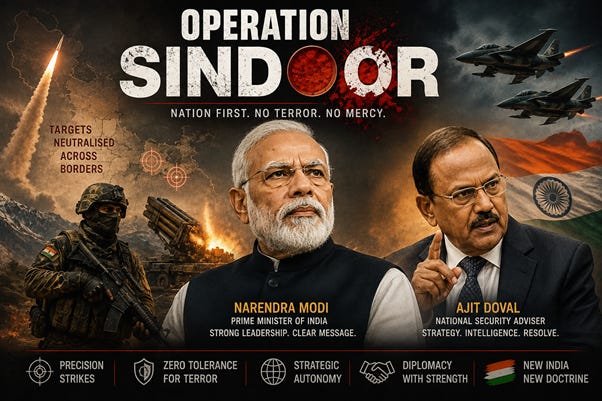
The phrase “Modi Doctrine” has appeared in strategic commentary, particularly in relation to India’s increasingly assertive responses to terrorism and its willingness to use multiple instruments of national power. But one should distinguish between political-strategic doctrine and military doctrine.
A Prime Minister can establish a national strategic posture. He can define political red lines. He can change the threshold for retaliation. He can alter India’s diplomatic signalling. He can authorise the use of military power. But these political decisions do not automatically constitute military doctrine.
A genuine national security doctrine would require institutionalisation across government: political objectives, diplomatic instruments, economic measures, intelligence structures, military capabilities, information strategy and escalation management. There are signs that India is moving in this direction. But public statements alone are insufficient evidence.
Can General Rajiv Ghai’s Statements be Called a War Doctrine?
General Ghai’s statements are important precisely because of his position and experience. As DGMO during Operation Sindoor, he was directly associated with its planning and execution, and subsequently became Deputy Chief of Army Staff (Strategy). In June 2026 he was appointed Military Adviser to the National Security Council Secretariat, strengthening the institutional link between military planning and national security decision-making.
His description of Operation Sindoor as a “maturing” of India’s doctrine beyond the binaries of peace and war is therefore analytically important. Yet his statements should not themselves be called a war doctrine. Why? Because a doctrine has to be more than an articulation of one operation. Operation Sindoor was a particular campaign responding to a particular political situation. A doctrine must have broader applicability. It must identify enduring principles. It must be institutionalised. It must guide force development, training, organisation, planning and operations beyond one conflict.
It must be capable of application against different contingencies. Ghai’s statements instead provide evidence of lessons emerging from an operation and of an evolving strategic concept. They may ultimately contribute to a new doctrine. They are not, by themselves, that doctrine.The distinction is crucial.
What about NSA Ajit Doval’s Statements?
Doval’s statements are at a different level because he represents the national-security establishment rather than a military service. His recent articulation that terrorism will be pursued wherever it originates, coupled with the warning that Indian restraint should not be interpreted as weakness, communicates a political-strategic message.It potentially establishes several principles. India intends to impose costs on terrorist organisations.
Geographic sanctuary will not necessarily guarantee immunity. The state sponsors or enables terrorism may increasingly become part of the target set. Military retaliation may be calibrated rather than automatically escalating to full-scale war. Diplomatic, economic, informational and military instruments may be employed together.Most importantly, the boundary between “terrorism” and “war” is being reconsidered. These are major strategic signals.
But they remain strategic principles and deterrence messaging, not a complete military doctrine. The distinction is similar to that between a government’s decision to “retaliate against aggression” and an army’s doctrine describing how combined forces should conduct the retaliation. The former determines political intent. The latter determines military method.
Part II Follows- Will Cover – Will doctrine survive the Commander and how will India fight a War