PART-2 BRICS at Twenty: Can India Turn a China-Heavy Economic Bloc into a Pillar of a Multipolar World?
- November 23, 2026
- Posted by: By Maj. Gen. Dr. Rajan Kochhar, VSM
- Categories: China, India
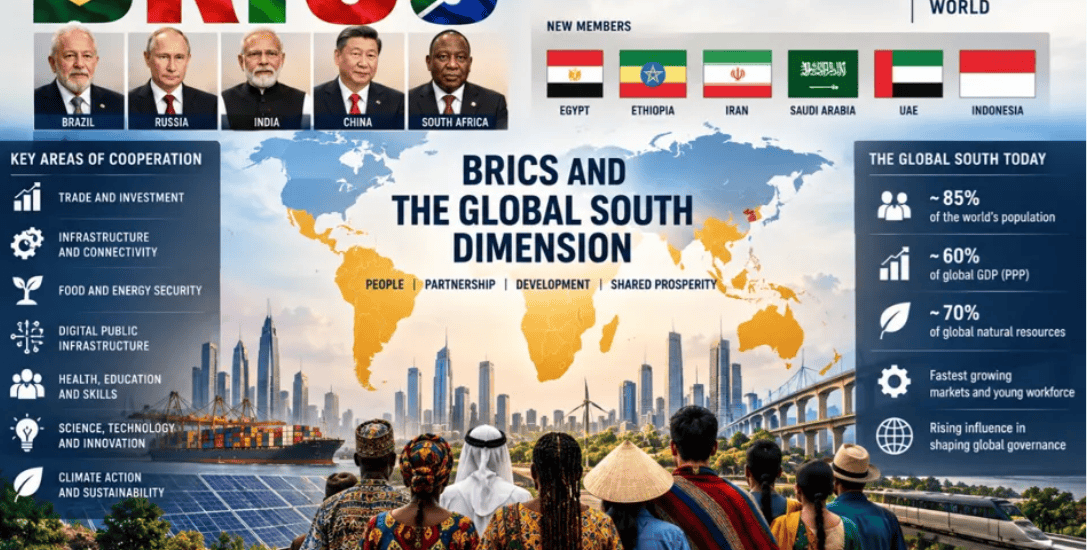
The strategic opportunity for India is to ensure that BRICS does not become a Chinese bloc, a Russian geopolitical instrument or an anti-Western coalition.
PART-1 BRICS at Twenty: Can India Turn a China-Heavy Economic Bloc into a Pillar of a Multipolar World?
·
Sep 10
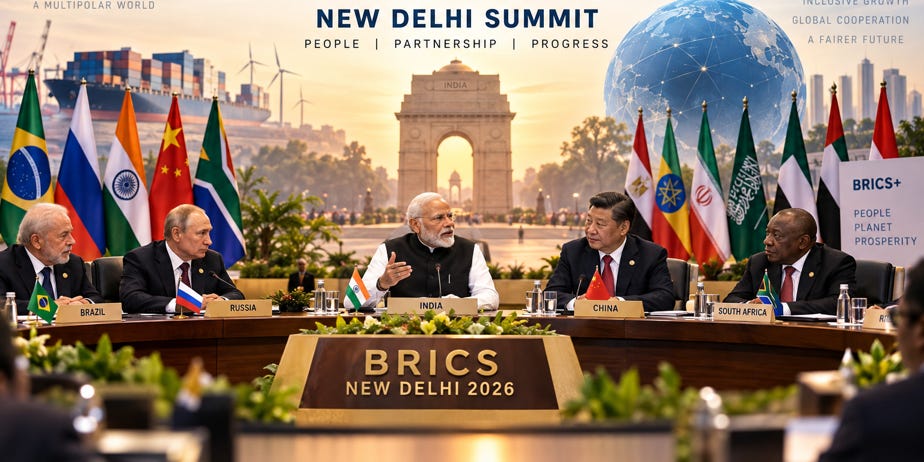
The 18th BRICS Summit in New Delhi on 12–13 September 2026 comes at a particularly consequential moment in the evolution of the international system. BRICS is no longer the relatively compact grouping of Brazil, Russia, India, China and South Africa that once represented a loose coalition of emerging economies. It has expanded to
BRICS and Global Supply Chains
The post-pandemic world has demonstrated the dangers of excessive dependence on a single geography. The Russia-Ukraine conflict, Red Sea disruptions, US-China competition and energy shocks have all exposed vulnerabilities in global supply chains.
Thanks for reading! Subscribe for free to receive new posts and support my work.Subscribe
BRICS collectively possesses many of the ingredients required to construct alternative and diversified supply chains: energy from Russia and the Gulf, manufacturing from China and India, agricultural resources from Brazil and other members, minerals from Africa, markets across Asia and technological capabilities distributed across several members.
India should therefore make supply-chain resilience one of the principal economic pillars of BRICS. The Global Value Chains Action Plan 2026–2030 is an important beginning. It seeks greater diversification and cooperation in areas including pharmaceuticals and food security. For India, this is directly aligned with Make in India, Atmanirbhar Bharat and the country’s effort to become a major manufacturing and logistics hub. BRICS could become a market into which Indian manufacturing expands rather than simply a diplomatic grouping.
The Global South Dimension
Perhaps the greatest strategic opportunity for India lies here. India has increasingly positioned itself as a voice of the Global South. BRICS provides an institutional platform through which that role can be consolidated.
The developing world does not necessarily want to choose between Washington and Beijing. Many countries want investment from China, technology from the West, energy from Russia and the Gulf, markets in India and Europe, and security partnerships with multiple powers. This is the essence of strategic autonomy. India should therefore resist attempts to define BRICS as an anti-Western organisation.The message should instead be: “BRICS is not against the West; BRICS is for a more representative world.” That distinction could become India’s most important diplomatic contribution.
What About New Members in 2026?
At present, the immediate expectation should be cautious. BRICS already has 11 members and ten partner countries. The scale of the expanded organisation makes further enlargement more complicated because consensus becomes increasingly difficult with every additional member.
Saudi Arabia is a particularly interesting case because its participation and formal status have generated some ambiguity in international reporting and policy discussions. But there is no compelling indication that New Delhi will turn the 2026 summit into another dramatic expansion exercise. Indeed, India has a strong reason to consolidate before expanding.
The partner-country mechanism gives BRICS a useful intermediate layer. Countries such as Malaysia, Thailand, Vietnam, Nigeria, Kazakhstan and Uzbekistan can engage without immediately becoming full members. This may be strategically preferable. BRICS should first learn how to function effectively as an 11-member organisation before becoming a 15-, 20- or 25-member grouping. A large organisation without institutional depth risks becoming a talking shop.
The West Asia Problem
The most immediate test for India’s diplomacy is not economics but geopolitics. The current West Asian conflict places Iran, Saudi Arabia and the UAE — countries with different strategic interests — within the same BRICS framework. The conflict has already complicated negotiations over a common BRICS statement. Indian diplomats have been working to bridge differences among members over language relating to the crisis.
This illustrates both the strength and weakness of BRICS. It is sufficiently broad to include countries that normally sit on opposite sides of regional disputes. But precisely because of that diversity, consensus is difficult. India should not attempt to force ideological unanimity.
The better strategy is to identify the minimum common denominator: protection of civilians, freedom of navigation, energy security, respect for sovereignty, de-escalation and diplomatic resolution.
If India can achieve consensus around such principles without turning the declaration into an anti-American or anti-Israeli document, it would demonstrate diplomatic maturity.
BRICS Must Avoid Becoming Another Bureaucratic Bloc
There is a danger that BRICS could reproduce the weaknesses of other multilateral organisations. Hundreds of meetings can generate hundreds of declarations, but declarations do not necessarily generate economic transformation.
India’s presidency has already conducted more than 350 meetings and high-level engagements across more than 25 Indian cities. The challenge now is to convert this enormous diplomatic activity into measurable outcomes. The Delhi summit should therefore identify a limited number of flagship projects with measurable targets. A BRICS payment-interoperability network. A BRICS supply-chain resilience mechanism. A BRICS startup and innovation fund. A stronger NDB. A BRICS logistics cooperation framework. A BRICS health-security network. A BRICS technology and AI cooperation mechanism. A BRICS MSME trade-finance platform. These would have greater long-term significance than another 100-paragraph declaration.
What Would a Successful Indian Presidency Look Like?
India should measure success against five criteria.
First, BRICS must remain united despite geopolitical disagreements. Second, India should prevent the organisation from becoming explicitly anti-Western. Third, economic cooperation must produce practical outcomes in trade, finance, technology and supply chains. Fourth, the Global South must receive a stronger collective voice in global governance. Fifth, China must remain an important member of BRICS without becoming its de facto leader. If New Delhi achieves these objectives, the 2026 summit could become a turning point.
BRICS and the Emerging Multipolar World
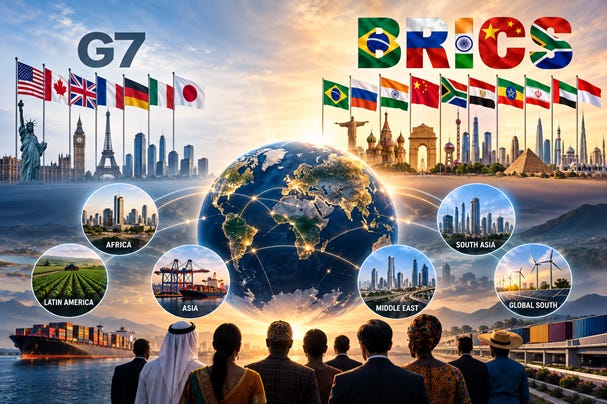
The deeper significance of BRICS lies in the changing structure of international power. The post-1945 order was constructed around institutions dominated by the United States and its Western allies. The post-Cold War period reinforced that dominance.But the world of 2026 is different.
China has emerged as a global manufacturing and technological power. India is one of the world’s major growth engines. Russia remains an energy and military power. Brazil is an agricultural giant. The Gulf states possess enormous financial and energy resources. Indonesia is becoming a major economic power. Africa is increasingly central to global demographics and resource security.
BRICS brings several of these forces together. It does not constitute a replacement for the Western system. Nor should it. Instead, it represents the emergence of institutional pluralism — a world in which no single economic or political centre can dictate all the rules. That may ultimately be BRICS’s greatest contribution.
India’s Strategic Opportunity
For India, the BRICS presidency is an opportunity to demonstrate that strategic autonomy is not neutrality. India can simultaneously cooperate with the United States through the Quad, maintain strong relations with Europe, work with Russia, compete with China, engage the Gulf, partner with Africa and lead the Global South. That is not contradiction. That is multipolar diplomacy.
India’s greatest achievement in New Delhi would therefore be to establish BRICS as a platform where countries with fundamentally different political systems and strategic interests can cooperate on common economic problems without being compelled into a common geopolitical ideology.
This is where India’s leadership can make a genuine difference. China possesses greater economic weight. Russia possesses energy and military power. Brazil possesses agricultural strength. The Gulf members possess energy and capital. India possesses the ability to connect these different worlds. That may ultimately be more valuable than simply possessing the largest economy within the grouping.
Conclusion: From BRICS to a New Architecture of Cooperation
The New Delhi BRICS Summit should not be judged by whether it declares a new currency, attacks the dollar, condemns the West or announces a spectacular expansion. Those would make dramatic headlines but would not necessarily create lasting strategic value.
The real test is whether BRICS can move from political symbolism to institutional capability. Can it increase intra-BRICS trade? Can it build resilient supply chains? Can it reduce transaction costs? Can it strengthen development finance? Can it support MSMEs? Can it create interoperable digital payment systems? Can it cooperate on AI, healthcare, agriculture and climate technology? Can it provide developing nations with greater representation in global institutions?
If the answer to these questions is yes, BRICS will become an important pillar of the world economy. If the organisation instead becomes primarily a vehicle for opposing the United States and the West, it will remain constrained by its own internal contradictions. The most appropriate strategic formulation for India is therefore not “BRICS versus G7.” It is “BRICS alongside the G7, but with a stronger voice for the emerging world.” The two systems can compete, cooperate and coexist.
The international order is already becoming multipolar. BRICS is one of the institutions through which that transformation is taking place. India now has the opportunity to determine what kind of institution BRICS becomes. As India’s External Affairs Minister has articulated, the objective of the Indian chair ship is to make BRICS “inclusive, practical, people-centric and outcome-oriented.”
That is precisely the direction BRICS needs. The strategic opportunity for India is to ensure that BRICS does not become a Chinese bloc, a Russian geopolitical instrument or an anti-Western coalition. It should become something more consequential: an effective economic and diplomatic platform through which the Global South acquires greater agency in shaping the 21st-century international order. And that is why the Delhi summit matters.