Makkah (Mecca) Joint Agreement: Geopolitically Fragile – Militarily Reinforcing
- September 30, 2026
- Posted by: Lt Gen Anil Ahuja
- Categories: Pakistan, Saudi Arabia, Turkey
Lt Gen Anil Ahuja, PVSM, UYSM, AVSM, SM, VSM & BAR (Retd.) – Distinguished Fellow, VIF
The Agreement
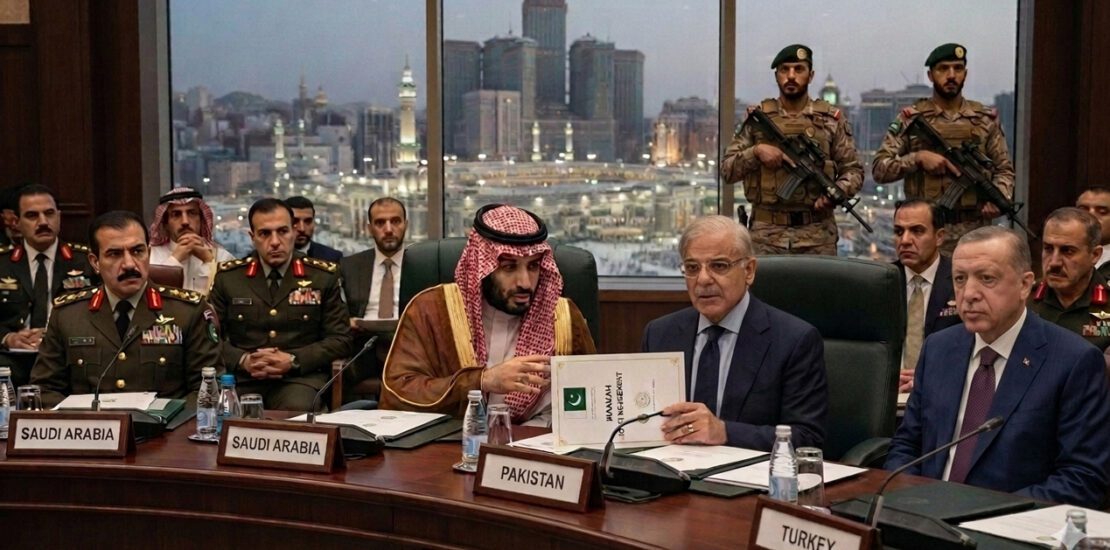
A trilateral Defence Agreement was signed by Saudi Arabia, Türkiye, and Pakistan at the Makkah Al–Mukarramah (Mecca) Summit on August 07, 2026. It follows the Pakistan– Saudi Arabia Strategic Mutual Defence Agreement (SMDA), signed on September 17, 2025. It also builds on an earlier Trilateral Saudi Arabia, Turkey, and Pakistan defence industrial forum in place since around 2022- 2023, synergising the technological, financial, and military resources of the three countries.
While the detailed text and implementation arrangements of the agreements have not been made public, the Joint statement of the recent trilateral defence agreement states that there is a “shared commitment to further strengthening their collective security and to promoting peace, security, and stability in the region and beyond, in pursuit of a secure and prosperous future.” It stipulates that “an armed attack against any one of the three states shall be regarded as an attack against them all.” The statement, however, remains ambiguous on the extent and nature of the commitment to each other’s defence.
Subsequent statements by Turkish Vice President Cevdet Yilmaz stated that the agreement was not aimed at any specific country. It was described as being purely defensive and that it did not supersede any existing agreements the countries had with other states. An intent to pursue deeper political and military cooperation, including joint exercises, defence-industrial collaboration, technology transfer, and intelligence sharing, has also been indicated.
This commentary examines the drivers and implementation challenges of the agreement and assesses its likely defence and military implications for India.
The Drivers
The agreement, which had reportedly been long in the making, was finally signed on August 07, 2026, nearly five months into the US-Israel war on Iran. This period has seen the Gulf countries, including Saudi Arabia, subjected to drone and missile attacks from Iran. The resumption of Houthi attacks on Saudi infrastructure and oil tankers in the Red Sea, and threats of a maritime blockade, have further threatened Saudi Arabia’s security. While the recent conflict with Iran may not have been the primary driver, it certainly has been the trigger for the conclusion of this pact now.
The agreement has been projected and perceived differently by various analysts: a hedge against the weakening US security umbrella and waning US interest – shifting from a security guarantor to an integrator in West Asia (Middle East); an indictment of the `west’ in general; an additional layer of collective regional security against the belligerence of Iran (and its proxies); a collective deterrence against Israel; leveraging of Pakistan’s military power & nuclear umbrella for the partners, an outreach for regional influence by Turkey……. and more.
Imran Khurshid, writing for the Asia Times, summarised the drivers as Saudi Arabia’s quest to address its vulnerabilities, the manifestation of Turkish ambitions in the region, and Pakistan’s endeavour to leverage its military muscle for financial support to keep its economy afloat.
One Agreement – Different Calculations
Through this agreement, Saudi Arabia endeavours to leverage its economic muscle, geostrategic location and leadership of the Sunni world to create an additional layer of security, particularly against Iran. It also endeavours to strengthen its technological and defence industrial base and promote self-reliance through indigenisation. Its larger ambition being to keep its Vision 2030 on track.
Turkey, a NATO member, brings to this grouping the strength of its defence technology and industry. It also leverages its regional influence as a security provider with military deployments and bases across Qatar, Syria, Iraq, Somalia, North Cyprus, Libya…The agreement could also serve as Turkey’s hedge against Israeli and other threats. Further, it could provide some assurance against Saudi actions against Turkey’s partners. Through its partnership with Pakistan, Turkey is also making an effort to extend its influence in South and Southeast Asia.
Pakistan is a vital partner in this pact, building on its long-standing military relationship with Saudi Arabia, including through the September 2025 SMDA. It brings to the partnership a significant contribution of operationally experienced military, which may be useful to both Saudi Arabia and Turkey. It also brings with it an ‘implicit strategic weight’ of a nuclear power- though its actual utility remains suspect for the partners in the agreement. In return, Pakistan expects ‘heft through association,’ financial support and bailouts for its fragile economy from Saudi Arabia. From Turkey, it seeks greater military and defence-industrial cooperation. A glimpse of this was evident in the support that Pakistan received from the latter during its conflict with India in May 2025 (Operation Sindoor).
Geopolitical Fragility – Implementation Challenges
The relevance of this Defence Agreement needs to be weighed alongside the implementation challenges. The challenges faced by Pakistan would be of particular relevance to India.
The recent conflicts in West Asia have exposed the limits of sole reliance on a US security umbrella for the Gulf countries. The agreement is unambiguously an effort to create an additional layer of security. This `hedging’ (diversification), however, needs to be done by all three partners without disregarding the long-standing and still relevant US-centered security architecture. It also has to be crafted as a `burden–sharing’ arrangement to ‘help the US advance its interests.’ Evidence of this approach being acceptable to the US is evident from President Trump’s statement of August 16, 2026, `hailing’ the agreement and appreciating the three countries coming together to defend themselves.
For Turkey, a NATO member, its quest to expand defence relationships with other regional partners needs to be progressed without diluting its commitment to NATO. It also needs to be presented as an opportunity to forge links between the Euro-Atlantic security system and the Middle East – South Asia security sphere.
Much greater implementation challenges are, however, likely to be faced by Pakistan, probably the weakest partner in this relationship. The objectives it aspires to achieve through this and other related agreements are hugely `aspirational.’ While it projects itself as the only Muslim Nuclear power, it is clear that this agreement does not extend Pakistan’s nuclear deterrence to the other partners. A US – Saudi Arabia Civil Nuclear Cooperation Agreement was concluded in July 2026. Implementation, however, has been made contingent upon Saudi Arabia acceding to the Abraham Accords and normalisation of relations with Israel. It appears most unlikely that the US or other members of the Nuclear Suppliers Group (NSG) will allow Pakistan to proliferate further and fill this nuclear cooperation void, particularly with the Chinese connection to its nuclear programme. So, in effect, what Pakistan brings is strategic signalling and psychological weight rather than an extended nuclear umbrella to its partners.
Pakistan could also find itself forced to subordinate its own national interests to those of more dominant partners, viz Saudi Arabia and Turkey. It may well get drawn into conflicts and security operations in Yemen, Syria, Somalia (with which it signed a defence cooperation agreement on August 04, 2026) or even with Iran, if Saudi or Turkish interests are directly challenged. That would be to its own detriment. Closer home, Pakistan, with its primary threat perceived from India, and with ongoing commitments on its Western borders and a disturbed situation in various Provinces, would find it hard to balance conflicting demands. There are also limits to the force levels (troops and equipment) that can be spared for external contingencies.
A significant challenge to the operationalisation of this agreement is the lack of institutionalised structures for joint defence planning, command and control, intelligence sharing, and politico-military oversight – as seen in organisations like NATO. In the absence of these, the agreement remains an un-operationalised symbolic alignment. This is, however, understandable in the near term. Developments in this regard and additional membership of the agreement would need to be monitored.
The Military Dimension
Despite the geopolitical and strategic incongruities, the tripartite defence agreement brings together the three professional militaries, each with its strengths. All three countries have credible armed forces, with Turkey, Pakistan and Saudi Arabia ranked 9th, 14th and 25th respectively (out of 145 countries) on the Global Firepower Index 2026.
Saudi Arabia
Saudi Arabia has one of the largest and most technologically advanced militaries in West Asia. It is the third-largest importer of major arms (according to SIPRI data for the period 2021-2025). Its estimated defence expenditure for 2026 is nearly $ 85 billion, which translates to about 6.3% of the GDP. Of its major arms imports during the last five years, 77% were acquired from the US. Even for the US, it remains the largest customer, procuring 12% of its arms exports.
Its inventory includes F-15 fighters, M1A2 Abram tanks, Patriot-3/ THAAD from the US; Eurofighter Typhoon and Tornados from the UK, Germany and Italy; corvettes and Infantry fighting vehicles (IFVs) from France and Canada; air-to-air refuellers from Spain…… In the recent past, it has diversified its acquisitions from China (DF-21, Artillery howitzers and UAVs), Russia, South Korea, and Brazil.
Turkey and Saudi Arabia signed a $ 3 billion defence deal in 2023, Turkey’s largest, for the export of Bayraktar Akinci HALE UCAVs, including technology transfer.
With Pakistan, Saudi Arabia has historically maintained a Special relationship, including in the military domain. It includes troop deployments, intelligence sharing, training (including Air Force pilot training), and weapon procurements. The armed forces of the two countries also exercise together. These exercises would give the Pakistan military familiarisation access to advanced US/Western military equipment.
Pakistan has deployed troops in Saudi Arabia for decades to guard borders and key facilities. These troops (including pilots) fought alongside Saudis in Southern Yemen in the late 60s. Saudi Arabia has in the past also procured some military equipment and munitions manufactured by the Pakistan Ordnance Factories. The sale of China-Pakistan co-produced JF-17 aircraft to Saudi Arabia (jets-for-loan deal) is also reportedly being explored.
Going ahead, as part of its Vision 2030, Saudi Arabia is looking at developing indigenous defence manufacturing capability, aiming to achieve 50% indigenisation. Turkey and Pakistan would be potential partners in this endeavour. The potential for further Chinese arms inductions (directly or through Pakistan) also exists.
Turkey
Turkey has the second-largest armed forces among NATO members, after the US. A large number of its heavy weapons, including combat aircraft, helicopters, main battle tanks, and Armoured Personnel Carriers, are still of US origin. It has, however, now emerged as the 11th largest global exporter of major conventional arms. Its exports include Armed UAVs- Bayraktar series (TB2 and Akinci), FPVs and Kamikaze drones, Corvettes (MILGEM) – including weapons, sensors and platform management systems.
Pakistan and Turkey share a close, multidimensional defence partnership. Pakistan is the largest export destination for Turkish weapon systems, receiving nearly 16% of defence exports. These include UAVs, loiter and precision munitions, corvettes (MILGEM), avionics, targeting pods for JF-17, and electronic warfare equipment. They partner in ship design, F-16 and submarine modernisation. Pakistan is also a partner in Turkey’s KAAN stealth fighter development programme.
Military Implications for India
Viewed from a military perspective, the Mecca Agreement brings together three countries, with substantial military capability, each with its own characteristics. Turkey has been a NATO member since 1952 (since NATO’s first expansion). Initially, it largely possessed Western-origin military inventory for interoperability. It has, however, in recent years, substantially indigenised, with over 80% localisation. Turkish officials have claimed that “Turkish companies supplied 65 of every 100 UAVs sold globally.” Turkey, therefore, brings with it military capability, defence technology, and insights into NATO operational concepts, doctrines, tactics, drills and procedures.
Saudi Arabia’s military, whose recent major arms imports have been US–centric, and with its ongoing efforts at indigenisation and technology absorption, offers an opportunity for exposure to advanced systems as well as for co-development and co-production. With its strong economy and financial resources, it is also a potential defence market – as evident from the reported ‘jets for loan’ deal, mentioned above.
In recent months, Pakistan’s military seems to have consolidated its power, playing a lead role externally and internally. Under Field Marshal Munir, Pakistan has turned around its relations with the US, is playing a role in negotiations between the US and Iran, and has recently concluded various defence agreements. Internally, it has consolidated its position with the 27th Constitutional Amendment. Pakistan also enjoys all-weather relations with China, and its military imports 80% of its defence equipment from it. They are also cooperating in co- development programmes, including the JF-17 Fighter.
Between the three militaries, there exists mutual opportunity for exposure to Western and Chinese weapons, equipment, operational doctrine, Organisational structures, etc. While all sides are likely to respect necessary confidentiality, the wide exposure allows the Pakistan Army to evolve its indigenous organisations and operational capabilities through this exposure. This is also likely to strengthen its defence industrial and technological base. This may be of greater relevance than external ‘boots on the ground, ‘ which is unlikely.
Viewed from an operational perspective, the agreement has the potential for the three militaries to consolidate their capabilities for Intelligence, Surveillance & Reconnaissance (ISR), maritime (including underwater) domain awareness (MDA/UDA), intelligence sharing, Air and Missile defence, Unmanned systems, Precision strike, Cyber and electronic warfare, and logistic support. Training together, they could imbibe the best practices of the opposing major powers.
From the US perspective, the possible extension of the footprint of this Agreement, with a common religious strand, into South and Southeast Asia, should be a matter of concern. The extension of Turkish and Saudi ambitions, Saudi financial resources and Pakistan’s facilitation with possible Chinese acquiescence, could be detrimental to US interests in the Indo-Pacific.
Conclusion
The Mecca Joint Agreement has drawn considerable attention, as a pioneering West Asia regional security initiative aimed at diversifying security reliance from the US, without abandoning it. The agreement builds on the existing relations between the three countries, particularly in the field of defence and security. The agreement suggests aspirational objectives without adequate institutional underpinnings or sufficiently convergent geopolitical goals. In the field of defence, however, structures and implementation mechanisms for cooperative activities already exist. While developing joint operational capabilities, interoperability, and NATO-like structures may be far-fetched, for now, close coordination for capability development is a distinct possibility.
The capability development of the Pakistan Armed Forces should be of interest to India and factored into its future planning. These developments are likely to manifest subtly, without provoking direct conflict and without any external presence. India’s larger geopolitical heft and economy could well be leveraged to mitigate potential challenges emanating from this arrangement.