Koizumi’s India Visit: A New Phase in Japan–India Defence Cooperation
- November 27, 2026
- Posted by: Ambassador Gurjit Singh
- Categories: India, Japan
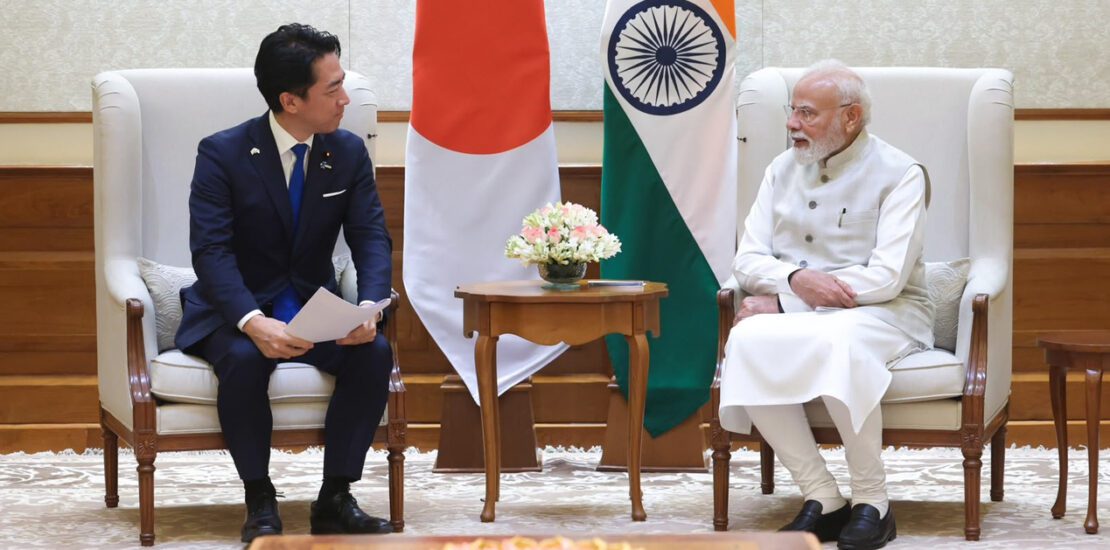
Japan’s Defence Minister Shinjiro Koizumi visited India from 19-20 August 2026. His first state visit to New Delhi marked an important step in India-Japan defence relations. Coming only weeks after Japan’s Prime Minister Sanae Takaichi visited India in July 2026, it should be seen as an attempt to translate the political understanding reached by Prime Minister Narendra Modi and PM Takaichi into practical defence cooperation.
The timing is particularly significant as Japan is seeking to strengthen its defence capabilities and further expand its role as a security provider, while India looks to trusted partners for defence co-development, maritime security and resilient manufacturing partnerships. The convergence of strategic interests between both countries is gradually translating the India-Japan defence partnership from political commitments into capability-oriented and institutionalised cooperation.
Koizumi’s visit followed his engagement in Australia on 18 August 2026. Taken together, the two visits illustrate Japan’s effort to build a network of capable security partners across the Indo-Pacific. Australia provides Japan with an interoperable defence partner, while India brings its position as a major maritime power in the Indian Ocean and a growing defence-industrial base.
From Strategic Convergence to Operational Cooperation
India and Japan have spent the past decade building the institutional foundations of their security relationship through the 2020 Acquisition and Cross-Servicing Agreement, the 2+2 dialogue and increasingly sophisticated military exercises. The next stage is to make this relationship operational.
The most important outcome of Koizumi’s visit was the signing of a Memorandum of Arrangement on Maritime Security Cooperation. It provides a framework for practical cooperation between the Indian Navy and the Japan Maritime Self-Defense Force, including maritime domain awareness, information sharing, search and rescue, humanitarian assistance and disaster relief, and protection of sea lanes of communication.
This maritime focus makes strategic sense. Both countries depend heavily on secure sea lanes for trade, energy and economic security. Japan’s dependence on maritime trade connects its interests directly with the Indian Ocean. At the same time, India has an equally strong interest in keeping the Indian Ocean and western Pacific connected and open. The two sides are also exploring reciprocal access to port and repair facilities. Indian facilities could support Japanese vessels operating west of the Malacca Strait, while Japanese facilities could support Indian deployments in the western Pacific. This could give the relationship greater operational depth.
Shipbuilding Could be the Game Changer
Perhaps the most promising long-term opportunity is naval shipbuilding and design. The two sides have agreed to explore joint development of naval platforms as well as ship designs, leveraging Japan’s technological and design expertise along with India’s expanding shipbuilding and production capabilities. Japan’s willingness to examine utilisation of Indian shipbuilding capacity under the ‘Make in India’ framework could further deepen industrial linkages, thereby moving bilateral defence cooperation towards co-development and co-production.
This represents a potentially important shift. Earlier defence cooperation was centred largely on exercises and the possibility of acquiring Japanese equipment. The emerging model is different: Japanese design and technology combined with Indian manufacturing and shipyards, with the resulting capabilities potentially deployed across the Indo-Pacific. If made commercially and technologically viable, this could become one of India’s most important defence-industrial partnerships.
Mine-countermeasures cooperation is another significant, if less visible, area. Japan has considerable expertise in mine warfare and maritime clearance, while India has a major interest in protecting ports and sea lanes. Cooperation could eventually extend to equipment, sensors, unmanned systems and training.
UNICORN: the Beginning of a Wider Technology Partnership
The UNICORN integrated communications antenna system remains the flagship India–Japan defence technology project. The two sides have described it as their first defence equipment transfer project and committed themselves to its early realisation. Its significance goes beyond the equipment itself. Japan has historically maintained significant restrictions on defence equipment exports and technology transfers. Its willingness to transfer defence technology to India signals a change in Tokyo’s approach.
For India, access to Japanese technology can complement its growing industrial and technological capabilities. The real test, however, will be what follows UNICORN. The two sides have directed their services to identify additional projects, while DRDO and Japan’s Acquisition, Technology and Logistics Agency (ATLA) will deepen cooperation. A Defence Industry Forum will also be established.
It is important not to overstate what has been achieved. No major jointly produced missile, fighter aircraft or naval platform was announced during the visit. Instead, the visit created mechanisms to move toward such cooperation. The July Modi–Takaichi summit provided the political commitment; Koizumi’s visit has begun implementation.
Exercises are Becoming More Serious
Military exercises are also moving from symbolism towards interoperability. The Dharma Guardian army exercise and JIMEX maritime exercise will be expanded. Veer Guardian 26 will see Japanese fighter aircraft participate in an exercise in India for the first time. The two sides also agreed to make exercises more complex, introduce unmanned systems and explore short-notice exercises. This is significant because air cooperation has traditionally lagged behind the maritime relationship. Japanese fighter aircraft operating from an Indian Air Force base would further provide an opportunity to improve air-combat training along with operational interoperability. It is also evident that exercises are laboratories for interoperability and not just a demonstration of friendship.
A Networked Indo-Pacific
The relationship is also acquiring a broader regional dimension, with India and Japan seeking to operationalise cooperation through partnerships with like-minded regional actors. The first India-Japan-Indonesia trilateral naval PASSEX in February 2026, followed by an agreement to expand such cooperation, reflects this approach. The ministers’ endorsement of greater utilisation of the Indo-Pacific Logistics Network, including for humanitarian assistance and disaster-relief operations (HADR), further underscores the emphasis on practical regional connectivity and collective capacity-building. India and Japan appear to be contributing to a networked regional security architecture which is characterised by issue-based cooperation and interoperable capabilities.
The Challenge is Implementation
Japan’s own defence transformation adds urgency to this relationship. Yet, India–Japan defence cooperation has often suffered less from a lack of political goodwill than from slow implementation. The proposed Director-General/Joint Secretary-level Working Group covering operations, intelligence, equipment, technology and industry is therefore, important. The decision to accelerate the fourth 2+2 Foreign and Defence Ministers’ meeting in Tokyo further reinforces institutionalisation.
Nevertheless, expectations should be realistic. Japan is deeply integrated with the US alliance, while India retains its strategic autonomy. The procurement systems and operational priorities of both India and Japan differ, and Japanese export regulations and Indian procedures can be demanding.
A Relationship Entering a New Phase
Koizumi’s visit is best characterised as a significant consolidation rather than a dramatic breakthrough. Its importance lies in several shifts: from exercises to interoperability; from equipment transfer to technology cooperation; from technology cooperation to co-development and co-production; from bilateral naval cooperation to Indo-Pacific networks; and from Japanese investment in India to potential Japanese use of Indian defence-industrial capacity.
The most promising development is joint naval shipbuilding and design. The most immediately operational is maritime-security cooperation and access to repair facilities. The most politically significant is UNICORN and Japan’s opening of its defence-technology ecosystem to India. The most strategically interesting is the emerging India–Japan–Indonesia maritime cooperation.
Against the backdrop of Prime Minister Takaichi’s July visit and Japan’s accelerating defence transformation, the message is becoming clear: Tokyo increasingly sees India not simply as a strategic partner in the Indian Ocean, but as an essential operational and defence-industrial partner in building a resilient Indo-Pacific. The next test is whether the new mechanisms can convert political convergence into actual ships, technologies, production lines and deployable capabilities. That is where this new phase of India–Japan defence cooperation will ultimately be judged.