Kashmir at a Turning Point: Sergio Gor, the Gen-Z Challenge and the New Test of Normalcy
- September 15, 2026
- Posted by: By Maj. Gen. Dr. Rajan Kochhar, VSM
- Categories: India, Kashmir
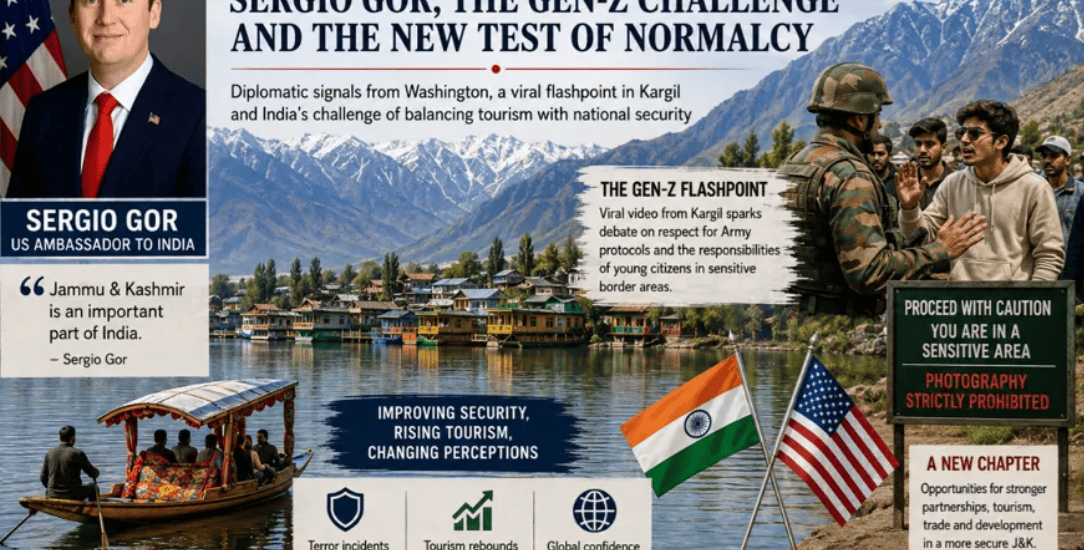
Washington is increasingly prepared to treat the security and political reality on the ground as a central part of its Kashmir assessment.
Part I — Sergio Gor’s Kashmir Visit: A Diplomatic Signal Beyond the Words
The visit of US Ambassador to India Sergio Gor to Jammu and Kashmir and Ladakh is important not merely because an American ambassador travelled to a region that Washington has traditionally treated through the prism of conflict, but because of what he chose to say after arriving there.
Thanks for reading! Subscribe for free to receive new posts and support my work.Subscribe
Gor described Jammu and Kashmir as an “important part of India”. He also indicated that the United States could reconsider its travel advisory for the region, citing improvements in security and the steps taken by the Indian and local governments.
The significance of the visit lies in the combination of location, timing and language. The United States has for decades maintained a carefully calibrated vocabulary on Kashmir. Washington traditionally avoided endorsing either India’s or Pakistan’s maximalist formulation, preferring language about a “dispute”, dialogue and peaceful resolution. The United States has also periodically expressed concern about terrorism, human rights and civilian unrest in Jammu and Kashmir.
Gor’s statement does not amount to a formal American recognition of India’s entire territorial claim over every part of the former princely state. Nor should it be interpreted as Washington abandoning every element of its traditional Kashmir policy. But it is nevertheless significant. Diplomatic language matters. When an American ambassador stands in Srinagar and publicly describes Jammu and Kashmir as an important part of India, rather than simply referring to it as a “disputed territory”, the political signal is unmistakable.
It indicates that Washington is increasingly prepared to treat the security and political reality on the ground as a central part of its Kashmir assessment.
Why the Timing Matters
The timing is particularly important. Gor’s visit comes after the April 2025 Pahalgam terrorist attack, India’s military response through Operation Sindoor, the subsequent India-Pakistan military crisis and a period in which Kashmir’s security environment has continued to evolve.
The Pahalgam attack had temporarily shattered the perception of Kashmir as a region moving steadily towards normal tourism and economic integration. Twenty-six people were killed, most of them tourists, in the April 2025 attack. The consequences for tourism were severe. Yet the broader security trajectory has also been moving in the opposite direction.
Government data indicates that civilian fatalities in terror-related incidents fell from 55 in 2018 to 28 in 2025, while security-force fatalities fell from 91 to 16 over the same period. That does not mean terrorism has disappeared. Recent search operations in Udhampur, Reasi and Kathua demonstrate that the threat remains real and that the security grid cannot afford complacency.
The more accurate conclusion is therefore that Kashmir has moved from an environment of pervasive instability towards one of substantially improved but still contested security. That distinction is critical.
Is This a Change in US Foreign Policy?
The answer is: yes, but it is an evolution rather than a formal policy reversal. It would be premature to declare that the United States has abandoned its traditional position on Kashmir. There has been no treaty, presidential declaration or State Department policy paper announcing such a transformation. But diplomacy does not change only through formal documents.Policy also changes through accumulated signals. Gor’s visit is one such signal.
The fact that the US ambassador travelled to Srinagar and Ladakh, met the elected Chief Minister of Jammu and Kashmir and publicly acknowledged security improvements demonstrates a greater willingness to engage with the region as a place of governance, investment, tourism and economic opportunity rather than exclusively as a conflict zone. The change is particularly visible in the travel advisory.
As of the latest US State Department advisory, Jammu and Kashmir remains under a Level 4 “Do Not Travel” warning, although eastern Ladakh and Leh are treated differently. The advisory cites terrorism and civil unrest. Gor’s statement therefore does not mean that the advisory has already been downgraded. It means Washington is reviewing whether its existing risk assessment still accurately reflects conditions on the ground. That distinction should be made very clearly. The advisory is still in place. But the fact that Washington is reconsidering it is itself an important diplomatic development.
The Travel Advisory Could Become More Important Than the Political Statement
For Kashmir’s economy, the travel advisory may ultimately matter more than the diplomatic rhetoric. American tourists are not the largest component of Kashmir’s tourism market. But American travel advisories influence perceptions well beyond American citizens.
Tour operators, insurance companies, universities, corporate travellers and travellers from Europe, Australia and other Western countries routinely examine the security assessments issued by major Western governments before making decisions. A downgrade by Washington could therefore have a multiplier effect. It could tell international tourists that Kashmir is no longer viewed exclusively as a high-risk conflict destination.
That perception matters enormously because tourism is fundamentally an industry of confidence. A hotel room can be built in months. A road can be constructed in years. But international confidence can take decades to establish and can disappear overnight.Kashmir experienced precisely that vulnerability after Pahalgam.
Official data showed that tourism suffered a substantial decline in 2025. Jammu and Kashmir recorded about 11.1 lakh domestic tourist arrivals and 22,993 foreign tourists, compared with much higher figures in 2024. Tourism contributes approximately 6.98 per cent to J&K’s Gross State Domestic Product. A sustained improvement in Western travel advisories could therefore help restore the international segment of Kashmir’s tourism economy.
From Security Narrative to Economic Narrative
This is perhaps the most important implication of Gor’s visit. For years, Kashmir’s international narrative was dominated by terrorism, militancy, India-Pakistan rivalry, human rights and political unrest. The emerging narrative is different. Security remains central, but tourism, investment, infrastructure, connectivity, education, technology and employment are becoming equally important. That is a profound strategic change.
A conflict region becomes normal not merely when guns fall silent. It becomes normal when investors stop asking whether the conflict will return, tourists stop asking whether they will be safe, young people stop viewing the security forces through the prism of conflict, and international governments stop issuing extraordinary warnings. In this sense, normalcy is a perception as much as a security condition.
Pakistan’s Reaction: Why Islamabad Is Concerned
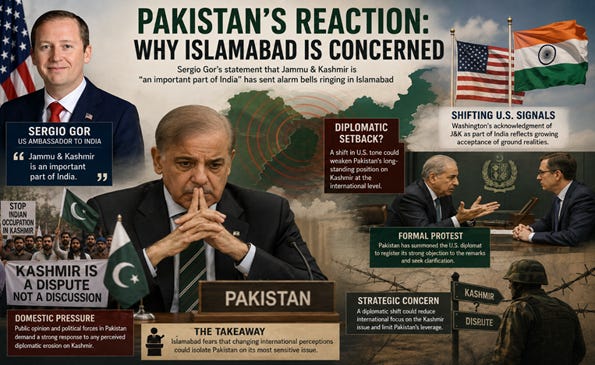
Pakistan’s reaction was immediate and sharp. Islamabad lodged a formal protest with the United States, objecting to Gor’s description of Jammu and Kashmir as an important part of India. Pakistan argued that the statement contradicted what it considers the established US position on the Kashmir dispute. Pakistan’s reaction is understandable from its strategic perspective.
For Islamabad, the Kashmir dispute has been one of the principal pillars of its foreign-policy narrative. Any major power appearing to move towards accepting India’s political and territorial framing weakens Pakistan’s diplomatic leverage. More importantly, the statement came from the United States.
Pakistan can dismiss an Indian statement as expected. It cannot so easily dismiss the words of the American ambassador. Washington has historically possessed enormous diplomatic influence in South Asia. Therefore, the political cost to Islamabad of an American shift in vocabulary is considerably higher. Pakistan’s concern is not simply the phrase “part of India”. The deeper concern is the possibility of international de-escalation of the Kashmir issue on India’s terms.
If Kashmir increasingly becomes viewed internationally as an Indian-administered region experiencing an improving security environment rather than primarily as an unresolved international dispute requiring external mediation, Pakistan’s diplomatic space narrows.
The International Perception of Kashmir Is Changing — But Not Uniformly
It would nevertheless be a mistake for India to assume that the international perception of Kashmir has completely changed. It has not. There are still Western governments that maintain serious security warnings for Jammu and Kashmir. The UK, for example, continues to warn of terrorist threats and heavy security presence in the region. There are also international organisations and political actors that continue to raise human-rights concerns.
The European Union’s recent engagement with Pakistan also demonstrated that Kashmir remains part of the diplomatic vocabulary of some Western partners, despite India’s objections. Thus, the emerging international perception is more differentiated. Kashmir is no longer automatically viewed as synonymous with insurgency. But neither is it universally regarded as an entirely normal region.India has therefore reached an important intermediate stage.The challenge now is to convert security improvement into internationally recognised normalcy.
India Must Now Do More Than Maintain Security
This is where India’s own responsibilities become critical. It is tempting to regard Gor’s statement as a diplomatic victory and leave the matter there. That would be a mistake. If India wants international perceptions to change permanently, it must ensure that the reality on the ground continues to justify that perception.
That means sustained counter-terrorism operations, but also political stability, good governance, economic development, employment, judicial credibility, human-rights sensitivity and responsive administration. The objective should not be to manufacture an image of normalcy.It should be to create normalcy so convincingly that the image follows automatically.
This is especially important because every terrorist attack against tourists has a disproportionate psychological effect. A single incident can undo years of confidence-building. Security forces therefore have an unusual dual responsibility: they must prevent terrorism while ensuring that their security architecture does not itself become so intrusive that it damages tourism and civilian confidence.That is a difficult balance.But it is precisely the balance required in a maturing security environment.
Tourism and Trade: The Next Opportunity
The economic consequences could be substantial. Kashmir’s tourism ecosystem extends far beyond hotels. It includes transport, houseboats, guides, pony operators, handicrafts, horticulture, restaurants, adventure tourism, aviation, local artisans and thousands of informal workers. A recovery in international tourism would therefore have a broad employment multiplier. Trade could benefit as well.
A safer perception facilitates logistics, conferences, business travel, hospitality investment and the movement of high-value visitors. Ladakh provides an instructive example.
Official figures show that Ladakh received 1,17,546 tourists between January and May 2026, compared with 81,827 during the same period in 2025 — a rise of 44 per cent. By July, Ladakh had recorded 3,30,332 tourist arrivals, almost matching its entire 2025 figure of 3,35,872. July alone registered more than 1.05 lakh visitors, a 56.15 per cent increase over July 2025. These numbers demonstrate that security confidence can return surprisingly quickly when travellers believe that conditions are manageable.The economic opportunity is therefore real.But it leads directly to the second part of the problem.