
Trump’s 50% pain, India’s 100% gain
- September 11, 2025
- Posted by: admin
- Categories: India, US
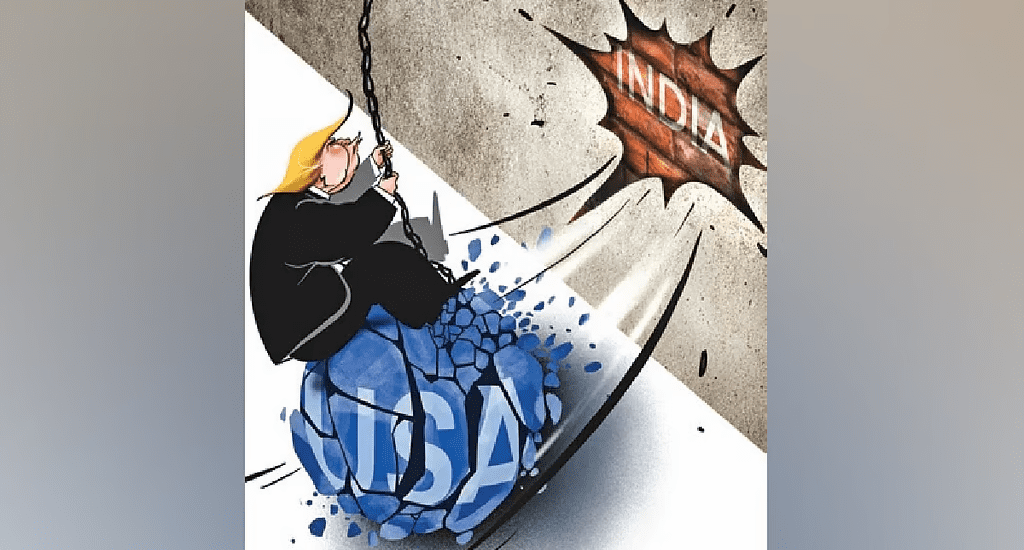
In this storm lies India’s chance to reshape its destiny with audacious reforms that ignite demand, attract investment, and rival China’s manufacturing might.
Prabhu Chawla
The paradox of power is that it burns the hands of those who mistake a mandate for a flaming sword. When a democratically elected leader like Donald Trump wields his mandate not as a trust but as a cudgel, slamming down sweeping tariffs to prop up the shimmering illusion of his ‘America First’ mirage, he does more than rattle rivals; he risks setting fire to the very foundations of his perverse economic dreamscape.
Trump’s terrible tariffs are a thunderbolt aimed at India’s economic heart. Pharmaceuticals ($12.2 billion), textiles ($8 billion), electronics, and automobiles—key pillars of India’s $74-billion US exports—face a 50 percent levy, potentially shaving more than 0.50 percent off the GDP, according to various estimates. The rupee, teetering at 87.95 to the dollar, amplifies the pain for India’s 400-million-strong middle class, whose purchasing power drives 50 percent of consumption.
Yet, in this storm lies India’s chance to reshape its destiny with audacious reforms that ignite demand, attract investment, and rival China’s manufacturing might. It requires a major reversal of economic model which places emphasis on supply. In fact, excessive supply hasn’t been able to create demand proportionally.
To spur demand, India’s middle class, burdened by a 30-40 percent income tax on earnings above Rs 15 lakh, needs urgent relief. Cutting the rate to 15 percent for incomes under Rs 15 lakh would lift disposable income by 12-15 percent, unlocking $50 billion in fresh consumption, according to Niti Aayog’s 2024 estimate. In rural India—where consumption grew just 4.5 percent in 2024 versus 6.2 percent in cities—direct cash transfers are essential. Expanding the Rs 2 lakh crore PM Garib Kalyan Anna Yojana to provide Rs 5,000 a month to 100 million rural families could drive a 10 percent surge in rural demand, adding 0.5 percent to GDP. Such a bottom-up strategy would replace the failed trickle-down approach, which has poured Rs 1.45 lakh crore into corporate tax cuts since 2019 with little to show for it in jobs.
Advertisement
01:50
Jobs must be the first order of business. Opening the doors to 100 percent FDI in defence, rural infrastructure, sanitation, water conservation, and road transport, paired with mandatory technology transfers, could transform the employment landscape. India’s $81-billion defence market, growing at 8 percent annually, could alone generate 1.2 million jobs by 2030. Road transport, the backbone of India’s $3.5-trillion economy, needs $500 billion for 100,000 km of new highways. Streamlined land acquisition and 20-year tax exemptions could lift FDI inflows by 30 percent, echoing Vietnam’s post-tariff gains.
Technology is India’s secret weapon. Trump’s H-1B visa curbs threaten the $250-billion IT sector employing 5.4 million. India must pivot inwards, incentivising firms like TCS and Infosys to develop AI, blockchain, and 6G solutions. A 2024 Nasscom report estimates that $1 billion in tech R&D creates 10,000 jobs; a $10-billion push could yield 100,000 jobs by 2028. Mandate Indian firms to invest 2 percent of revenue in R&D, up from 0.7 percent.
India’s corporate tax rate of 25 percent for new manufacturers is competitive. Simplifying GST to two slabs—5 and 15 percent—and decriminalising minor tax violations could cut costs by 20 percent, making India a manufacturing hub. China’s labour costs, 30 percent higher than India’s, give Modi’s ‘Make in India, Sold to the World’ vision a clear edge. Bold reforms could capture 25 percent of China’s $1-trillion export market by 2030.
Another bold reform is to leverage India’s $240 billion in US treasury bonds. Redirecting this to the $1.3 trillion National Infrastructure Pipeline yields 8 percent higher returns, says Niti Aayog. Amazon and Google, who rake in billions from India’s $2-trillion digital market, must face China-style rules. They should be forced to set up R&D centres with 50 percent local jobs or lose access. This could create 500,000 jobs by 2030.
The time has also come to end American ratings hegemony. Forge a system that serves India’s 1.4 billion people, not Wall Street’s whims. Moody’s, S&P, and Fitch consistently downgrade India’s potential, while China, with a slower 4.6 percent growth, enjoys A1. This bias, rooted in Western scepticism of India’s governance, costs $10 billion annually in higher borrowing costs, says RBI. Local agencies like CARE Ratings and ICRA, projecting 6.8 percent growth for 2025-26, reflect India’s true trajectory. Launch a BRICS-backed rating agency to challenge this cartel. As Finance Minister Nirmala Sitharaman quipped in 2024, “Why let New York tell us who we are?”
Advertisement
US consultancies like McKinsey, EY, and PwC, tainted by $641 million in US settlements for conflicts of interest, peddle generic solutions unfit for India’s 70 percent rural economy. Their advice fuels bureaucratic bloat which opens up unending consultancy avenues for them. India must establish a National Policy Research Institute staffed by IIT and IIM graduates to craft bespoke reforms. For instance, digitising land records with blockchain, as piloted in Telangana, could save $5 billion annually in disputes. Decriminalising minor GST and Companies Act violations would unlock $15 billion in capital, boosting small businesses. Mahindra Group Chairman Anand Mahindra’s rallying cry—“Ease of doing business is our shield against tariffs”—demands a follow-up. India’s 63rd rank in the World Bank’s ease of doing business index trails Vietnam’s 70th. Single-window clearance could propel India to the top 50, attracting $100 billion in FDI by 2030. India should adopt the mantra of building institutions for India.
By Trump and for Trump cannot be the rule. Tariffs—50 percent on India, with a 100 percent threat on BRICS for de-dollarisation—reveals America’s fear of a rising multipolar world. India, the world’s third-largest economy, must lead BRICS to redefine global trade, sideline the dollar, and stymie US economic nationalism. The US dollar, underpinning 88 percent of global trade via SWIFT, is America’s financial chokehold. India’s $10-billion rupee-ruble trade with Russia in 2024, up 20 percent from 2023, proves local currencies work. Scaling this across BRICS—$26 trillion in GDP—could save $20 billion. Restricting SWIFT, as China did with CIPS, shields trade from US sanctions. India must champion a BRICS trading currency backed by the New Development Bank.
India’s $250-billion trade with BRICS members grew 15 percent in 2024, but high tariffs limit its potential. CII estimates that a BRICS free trade agreement with 5 percent average tariffs could add $60 billion to India’s exports by 2030. Hosting a 2026 BRICS trade summit could cement India’s role as a global power. According to FT, Trump’s tariffs will reshape supply chains. In that case, India’s 44 percent share of US smartphone imports could net $50 billion in exports. Striking trade deals with the EU, UK, and ASEAN ($200 billion in 2024 trade) will amplify India’s dream of acquiring the role of a vishwaguru.
As Harsh Goenka, Chairman of the RPG Group, said, “Trump’s chaos is India’s chance to shine.” India must lead, not follow, turning adversity into a dazzling triumph. Trump’s tariff tyranny hands India a historic opportunity for triumph. By slashing taxes, opening FDI, and harnessing technology, India can forge a competitive economy. To repeat Mahindra’s war cry, “This is India’s moment to unleash its potential.” Make India Great (MIG)—boldly and brilliantly—starting now.
Read all columns by Prabhu Chawla
prabhu chawla
prabhuchawla@newindianexpress.com
Follow him on X @PrabhuChawla