Trump–Putin Summit signals a new Opening in Global Politics (Subtle Gain for India)
- September 13, 2025
- Posted by: Col Ashwani Sharma (retd)
- Categories: America, China, India, Russia, Ukraine, US
By: Col Ashwani Sharma (retd), Editor – in – Chief
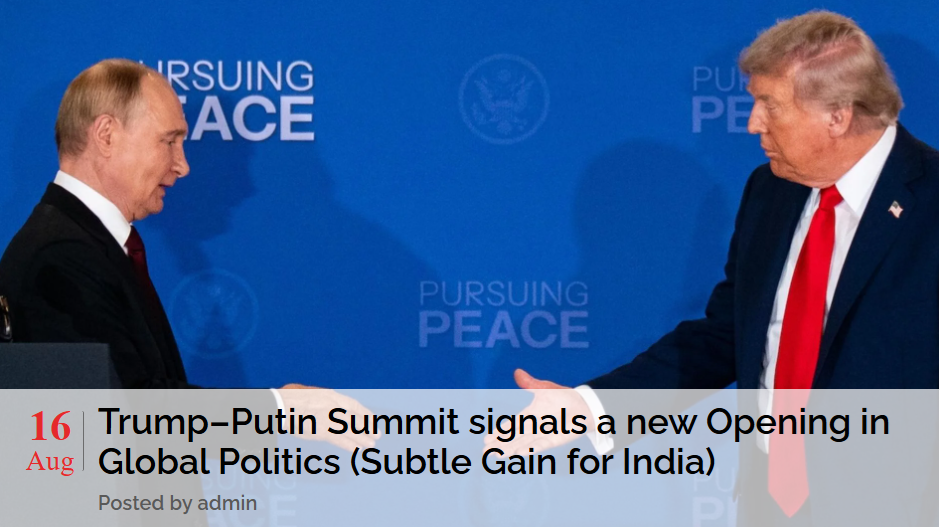
The August 15 summit did not produce a ceasefire or a peace treaty, but it served as a recalibrating gesture in global geopolitics. For the U.S., it is a bid to soften the Russia–China alignment and reinsert diplomatic flexibility into the Ukraine conflict. For Russia, it is a reclamation of international legitimacy and economic opportunity. For India, it is relief and strategic space, a subtle indirect gain born of great-power realignment.
While the official agenda was to discuss the Ukraine war and a possible ceasefire, the real purpose of the meeting seemed to lie elsewhere. With no direct involvement from Ukrainian President Volodymyr Zelensky and no concrete result on ending the conflict, it was clear that the summit was more about long-term positioning than immediate solutions.
For both leaders, the meeting offered an opportunity to showcase intent. For Trump, it was a chance to push for peace and appear as a peacemaker on the world stage. For Putin, the visit to American soil after many years, and being welcomed with diplomatic respect, sent a strong message that Russia is not isolated and still has a place in global affairs. Though no formal agreement was signed, the very act of holding such a high-level discussion can be seen as a thaw in relations that have remained tense for over a decade.
One likely strategic aim behind the U.S. initiative may have been to gradually wean Russia away from deeper alignment with China. While no mention of China dominated public discourse, Trump’s post‑summit remarks suggesting a temporary halting of tariffs on Chinese goods while progress was being made with Russia, hint at broader geopolitical bargaining. This manoeuvre underscores a broader U.S. intent to avoid cementing a Sino-Russian bloc by offering a path back into the Western orbit (even if symbolically) and prevent a full shift of power alignment.
Economic interests too played an important part in the meeting. Putin’s delegation included key financial and trade officials and he spoke of growth opportunities in areas like digital innovation, Arctic development, and cement etc pointing to mutual economic interests beyond the battlefield. The U.S., despite maintaining sanctions, might be open to selective cooperation in areas where interests align.
India’s Advantage. In this backdrop, India should find itself in a favourable position and could well be a key indirect beneficiary. India has tried to balance its relations with both the U.S. and Russia. In recent weeks, however, tensions rose as Trump imposed steep tariffs – 25 percent additional tariffs on Indian goods tied to its purchases of Russian oil and arms. Should U.S. Russia ties thaw, even incrementally, India may find itself in a more favourable position to navigate both partnerships. Any reduction in hostility between the two powers would relieve pressure on New Delhi and allow it more space to follow its (independent) foreign policy path.
Russia is unlikely to shift away from India anytime soon. The two countries share a deep history of defence, nuclear, and energy cooperation. Even as Russia opens up to the U.S., it will not want to weaken its bond with India. On the other hand, if the U.S. finds some common ground with Russia, it may also soften its current stance towards India, especially on issues like trade and arms purchases.
While the summit did not bring any dramatic change in global politics, its real value lies in the signals it sent. The meeting created an important opening towards easing tensions and possibly reshaping alliances. For the U.S., it was a step towards slowing down China’s rise as a unified bloc with Russia. For Russia, it was a return to international relevance. And for India, it was a quiet gain.
The full impact of the Trump-Putin meeting will become clear only in the months to come. But even without a ceasefire or a signed deal, the signs of positivity, engagement, and mutual interest are worth noting. In a world of shifting alliances, such gestures matter and India, as a steady partner may ride the wave with steadiness, leveraging its stable, long-standing relationships with both Washington and Moscow.