The Top 3 Delusions About the US-India Relationship
- July 29, 2025
- Posted by: admin
- Categories: India, US
By: Arun Sahgal, and Ambuj Sahu
The US-India relationship suffers from false assumptions about bipartisan support, strategic altruism, and misunderstandings that hinder realistic cooperation and fuel mistrust amid diverging geopolitical and cultural interests.
The US-India relationship is becoming increasingly strained with each passing day. The euphoria that swept New Delhi after President Trump’s 2024 election victory is now a thing of the past. Prime Minister Modi sought to appease Trump by making an early visit in February and prioritizing the most critical agenda close to him: trade and tariffs.
While the two countries were negotiating a trade deal, the dastardly state-sponsored terrorist attack in Kashmir triggered a military crisis between India and Pakistan that upended the trajectory of US-India ties.
Trump’s Response to the India-Pakistan Crisis
President Trump has repeatedly and publicly claimed that he mediated the crisis. India, meanwhile, maintains that the ceasefire followed a request from Pakistan via a military-to-military hotline. A significant milestone was crossed in the recent Trump-Modi phone call. PM Modi has conveyed that no conversation during the crisis included any proposal for third-party mediation or the use of trade as coercive leverage.
Thailand’s prime minister in hot water over leaked audio: 5 things to knowNikkei Asia
Sleep Apnea? Few Know This Pillow Trickderila-ergo.com
Notably, he declined to make a brief layover in the United States on his return from the recently concluded G7 summit in Calgary. Trump’s invitation came across as patronizing in New Delhi, especially when Field Marshal Asim Munir, Pakistan’s Army Chief, was already in Washington.
President Trump’s attempt to claim credit for a ceasefire, one that India insists he had no role in, mirrors the very pattern we outlined in our last article. The United States often speaks of supporting India’s rise as a regional power to counterbalance China, only to revert to its old habit of meddling in South Asia.
Yet, a prominent India watcher and US interlocutor has argued otherwise: that successive US administrations have “sought to help” India emerge as a great power, that still “fell short of its potential” and is “delusional” about its capability to balance China. He further suggested that India’s turn toward Hindu nationalism casts a long shadow over the future of the US-India partnership.
His claims reinforce three articles of faith widely held in the United States: that a bipartisan consensus on India has held firm for two decades; that the US invested generously in India’s rise to counter China; and that shared democratic values strengthen bilateral ties.
While this framework once fueled optimism, it now propagates a wishful and misleading narrative of the partnership. It locks the baseline of the relationship in 1998, when the US imposed sanctions after India’s nuclear tests, thus creating a false sense of progress and obscuring differences in the subcontinent. By setting unrealistic expectations through this eulogistic historiography, setbacks are often exaggerated, leading to moral posturing from Washington and public backlash in India.
Delusion 1: Republicans and Democrats View India in the Same Way
It is widely believed that US-India relations have enjoyed a bipartisan consensus across successive administrations, from Clinton to Biden. This view, however, is a textbook case of attribution bias. Foreign policy cannot be fully understood through a purely domestic lens; it must be situated within a strategic context.
Each administration’s approach to India was shaped by the world it inherited, not by some abstract consensus in Washington. A consistent strategic rationale shaped both engagement and estrangement between the countries. India aligned neatly in President Clinton’s post–Cold War enlargement strategy, which sought to expand engagement with the global community of democracies.
Under President Bush, India’s importance grew in the context of the War on Terror and as a key regional power in the Indian Ocean, an area gaining strategic relevance due to US interventions in the Middle East. Unlike Clinton, Bush recognized the risks posed by China’s unchecked rise.
President Obama’s Pivot to Asia elevated India’s salience in counterbalancing Beijing, while Presidents Trump and Biden confronted an assertive China, making India a strategic partner in the Indo-Pacific.
Moreover, the famed bipartisan consensus never existed. It was limited only to the Clinton and Bush administrations, both of which took significant steps to end India’s nuclear pariah status: first through lifting sanctions, and then through signing the landmark Civil Nuclear Agreement (CNA) in 2008. But notably, one of the most vocal opponents of the Hyde Act, which enabled the CNA, was then–Senator Barack Obama (IL-D), who advocated for the “Killer Amendments.”
Thailand’s prime minister in hot water over leaked audio: 5 things to knowSponsored | Nikkei Asia
Sleep Apnea? Few Know This Pillow TrickSponsored | derila-ergo.com
Pirates Approach a Cruise Ship – See How the Genius Captain Responds!Watch what happenedSponsored | Happy in Shape

Even President Bush reportedly acknowledged that the agreement might not have survived a change in administration or a flip in Congress.
Numerous negatives marked Obama’s presidency for India. His administration urged New Delhi to negotiate on Kashmir, omitted it from Secretary of State Hillary Clinton’s first Asia tour, flirted with the idea of a G2 with China that acknowledged Beijing’s role in South Asia, pressured India to cut oil imports from Iran, and presided over the humiliating arrest and mistreatment of an Indian woman diplomat. These episodes reveal the selective reading of US-India relations to create the myth of bipartisan consensus.
Delusion 2: The US Always Supported India’s Rise in Good Faith
It is often claimed that the United States has enabled India’s rise as a regional power altruistically. This idea draws heavily from a narrative centered around the 2008 Civil Nuclear Deal, which is still regarded in Washington as the defining milestone of progress. But limiting the relationship to that moment is like celebrating a race where the hare sprinted early and has slept since. Yes, the US bent the global non-proliferation regime to secure India a waiver in the Nuclear Suppliers Group.
Since then, the relationship has been judged by ceremonial markers, working groups formed, joint statements issued, military exercises held, and delegations exchanged. These may offer optics, but not strategic substance. In truth, India remains absent in America’s strategic imagination.
In an otherwise rich Senate testimony on Indo-Pacific alliances and burden-sharing in March 2025, India was mentioned only once, cited among countries that “cannot be relied upon to side with the United States.”
Economic and technological ties have grown, primarily for transactional purposes. The shift of US companies to India under the China+1 strategy is driven by market logic. Even the 2000s outsourcing boom in India was a result of global comparative advantage, not foreign policy calculus. Much of its footprint in the American technology sector is an organic result of the diaspora rising through the ranks in tech companies.
Even these ties remain subject to recurring disputes over tariffs, visas, and market access.
In defense, the distance between ambition and reality is stark. The GE-404 jet engine deal, considered as the next big leap after the civil-nuclear agreement, is still mired in bureaucracy. Projects like the Stryker armored vehicle, Javelin missiles, and sonobuoy co-productions are yet to pass the test of execution.
Washington may frame the US-India partnership as a strategic success story. But if one looks past the press releases and ribbon cuttings, it’s hard to deny that India’s rise has never been Washington’s project.
Delusion 3: India and the United States Share the Same Liberal Values
Another dogmatic view is that shared liberal democratic values are essential for a robust US-India relationship. This assumption, however, does not stand the test of history. Barring the brief interregnum during Indira Gandhi’s tenure, India has remained a thriving democracy. For decades, its political landscape was dominated by the Congress Party, whose leadership was distinctly left-of-center, progressive, Western-educated, and closer to so-called ‘democratic ideals’ than the Hindu nationalist Bhartiya Janta Party (BJP).
Yet during that very period, India and the United States found themselves on opposite sides. In the subcontinent, a democratic US balanced a democratic India by allying with a military rogue (Pakistan) and a communist dictatorship (China). If democratic alignment were truly the bedrock of the relationship, why did India’s credentials matter so little then, and why do they matter so much now?
Just as Cold War concerns over India’s alignment with the Soviet Union once overshadowed considerations of India’s democracy, the India-China rivalry should take precedence over preoccupations with India’s internal politics. Making a systemic explanation for the Cold War in India, but a domestic one for today’s India, is not analytically sound.
The plain dismissal of Hindu nationalism as an antagonistic force ignores the historical role of identity formation in rising powers. No great power in the modern era has expanded its influence without forging a distinct national identity, often rooted in civilizational pride or ideological conviction. Nineteenth-century Britain drew its confidence from the mythos of the Citizen of the Empire. France rallied under the eternal cry of Liberté, Égalité, Fraternité. German unification was propelled by the concept of Volksgeist, a shared cultural and ethnic spirit that united the people. Tsarist Russia mobilized as a great power by idolizing Moscow as the Third Rome. The rise of China was driven by a desire to restore national dignity after its “Century of Humiliation.” And could the United States have distinguished itself from European orthodoxies without imaginations like City upon a Hill and the American Dream?
How does a country as diverse as India forge a unified national identity and yet ignore the only strand that has preserved its civilizational continuity despite barbaric invasions and colonial exploitation? It is myopic to confine the identity of 1.5 billion people to the covenant of a 75-year-old republic or a post-colonial thought. These artefacts are merely a blip in five millennia of cultural memory.
If the US genuinely supports India’s rise, as it is suggested, it should not expect India to adopt values foreign to its traditions, which have shaped much of Asia.
What Is the Future of the US-India Relationship?
Do not be pessimistic about the future of the US-India relationship!
Quite the opposite: it holds immense potential. But potential cannot be realized through illusions. The durability of this partnership depends on a sober understanding, not sentimentalism.
The three delusions: bipartisan consensus, strategic altruism, and liberal value alignment- are not harmless myths. They distort expectations, cloud judgment, cause misperceptions, and create a feedback loop of disappointment. They also invite moral grandstanding from Washington and defensive resentment in New Delhi. Neither serves the cause of a stable and mature partnership.
Clearing these illusions is not cynicism, it is clarity. If the relationship is to grow on its own merit, it must be unshackled from the weight of exaggerated history. Let us move beyond self-congratulatory narratives and start treating this relationship for what it is: a hard-nosed convergence of interests that needs realism, not values, to succeed.
About the Authors: Arun Sahgal and Ambuj Sahu
Arun Sahgal is the Director of the Forum for Strategic Initiatives, a Delhi-based think tank. He was the founding Director of the Office of Net Assessment, Integrated Defense Staff (IDS), Ministry of Defence of India and head of the Centre for Strategic Studies and Simulation, United Services Institute of India, and Senior Fellow, Institute for Defence Studies and Analyses, New Delhi. He is involved in Track Two, dialogues on Nuclear CBM’s among others.
Ambuj Sahu is a PhD candidate at Indiana University Bloomington and writes about India’s foreign policy interests in the Indo-Pacific. He is also pursuing an MS in Applied Statistics. He originally studied electrical engineering at the Indian Institute of Technology Delhi. Follow him on X at @DarthThunderous.
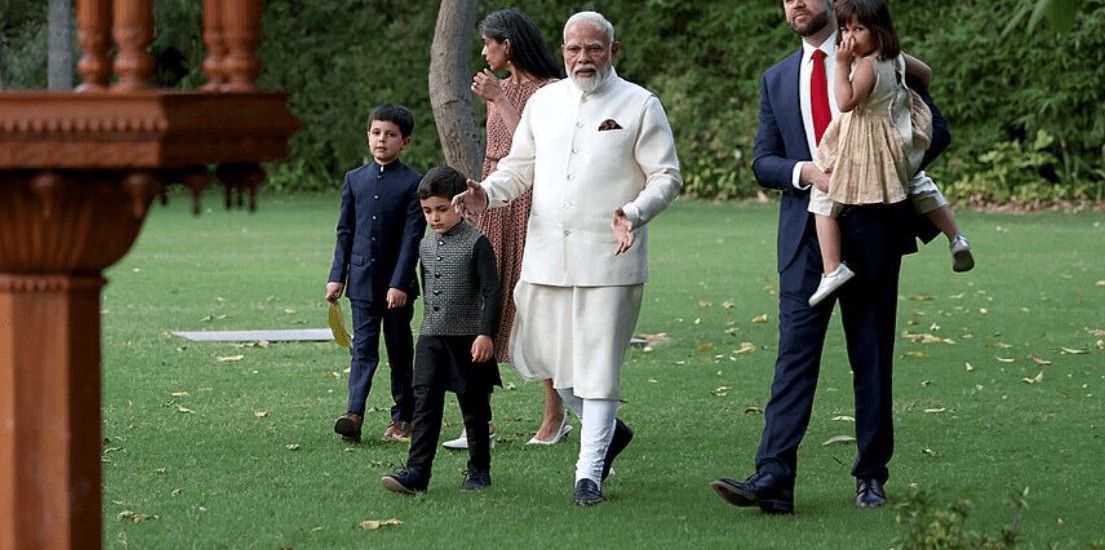
Image Credit: Wikimedia Commons/Prime Minister’s Office, Government of India.