
Integrated Air Defence Weapon System – a Round Peg in the Round Hole
- October 28, 2025
- Posted by: Lt Gen (Dr) V K Saxena (Retd), PVSM, AVSM, VSM
- Category: India
Lt Gen (Dr) V K Saxena (Retd), PVSM, AVSM, VSM
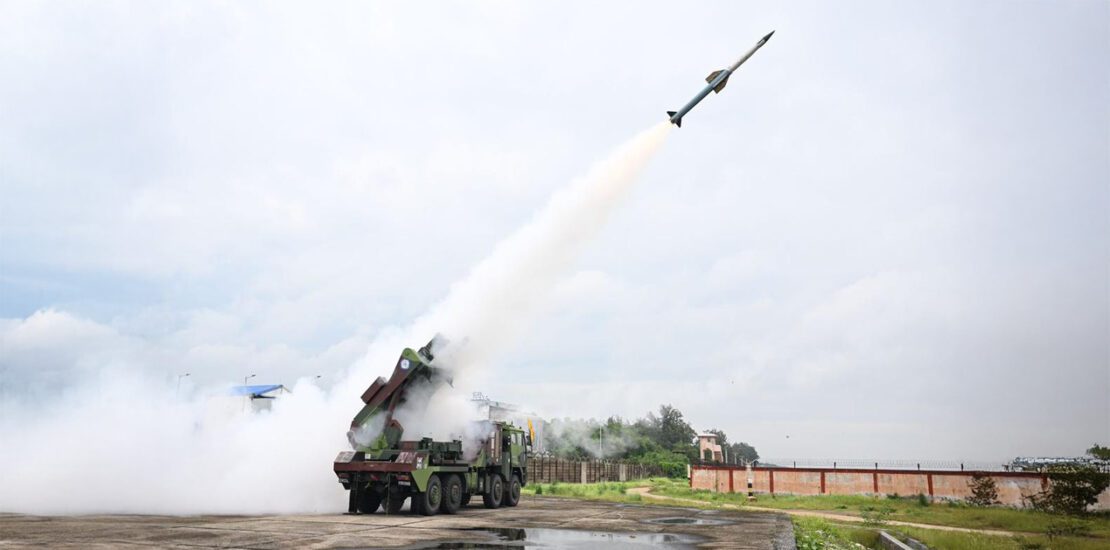
This article work presents an air defender’s point of view as to how the Integrated Air Defence Weapon System (IADWS) which underwent successful trials on 23 Aug 25[1] addresses a very critical and a long-standing void in Ground Based Air Defence (GBAD).
Building the Perspective of the Battlefield
GBAD – the ground based component of the overall air defence capability of the nation essentially provides air defence cover to ground-based critical assets considered vulnerable to the adversary’s air attacks. In addition, it is solely responsible to provide mobile air defence cover to the mechanized forces operating in the Tactical Battle Area or TBA for short.
TBA, is that forward zone of the battlefield where opposing forces engage in tactical engagements (military duels). It is in this zone where tank battles happen and ground forces encounter their adversary to shape the battle as it progresses.
By nature, TBA battles are fast and fluid presenting fleeting opportunities as forces maneuver to get to comparatively superior positions (higher ground, better look see, better fire position, concealed to enemy from certain direction, ability to surprise from behind cover etc.). Essentially, the TBA is filled with uncertainties and constantly features tactical scenarios that continue to evolve in real time. [2]
The forces that mainly operate in the TBA are battle tanks, BMPs, Infantry Combat Vehicles, High Mobility Vehicles (HMVs) carrying combat equipment and support and logistic echelons, mobile command control and communication networks and adomore.
What Flak is Faced in the TBA?
The air threat in the TBA will mainly be prosecuted by front line strike aircrafts duly ‘packaged as punch’ with aircrafts specifically tasked for suppressing enemy’s air defences, carrying out Electronic Warfare (EW) attacks, acting as decoys, and more.
TBA is also a primary zone of operations for the Attack Helicopters (AHs). These machines have the capability to fly in the nap-of-the-earth mode thus avoiding detection by ground-based radars. AHs can suddenly appear at dangerously close ranges having defied the entire air defence chain and deliver at maneuver elements lethal Precision Guided Munitions (PGMs) with needle sharp accuracy. Such munitions may include bombs, rockets, and anti-tank missiles and more.
TBA is also the domain of operations for precisely guided loitering munitions which lie in weight for their prey. Other munitions in the TBA battle are the standoff weapons which can be delivered from ranges well outside the track envelop of fire control radars of the air defence weapons.
Other weapons at play in the TBA will be Anti-Radiation Missiles (ARMs) trying to silence the air defence sensors and control nodes or the cruise missiles aiming to take out formation clusters, control nodes and other war-waging potential in precise strikes.
In addition to all the above, TBA is also the place where most of the drone and counter drone duels unfold either in the visual envelop or outside of it.
Air Defence Requirements in the TBA
The air defence requirements in the TBA are quite different from other areas of weapon deployments. The most demanding of all is the fact that the air defence weapons providing cover must enjoy the same (if not higher) degree of mobility as the mechanized forces so as to keep pace with them in time and space and be able to counter the threats on them in real time.
To be able to execute the above task, such weapons must be able to carry out surveillance and tracking of targets on the move (implying maintaining an Air Situation Picture or ASP that remains updated through connectivity to the higher air defence nodes in near real time).
Additionally such weapons must be able to deliver fire either while moving along with mechanized the forces or by taking minimally short halts.
It goes without saying that the air defence weapons must survive in a hostile EW environment against enemy’s onslaught of suppression and be capable to counter the entire spectrum of threat from aircrafts to AHs, ARMs, Cruise missiles, loitering munitions, PGMs, standoff weapons and the drones either in finite numbers or in swarms.
That we face a comprehensive air threat encompassing all the above and more from our two potential adversaries is a ‘given’ and not explained here due confines of space.
As to the range and reach (implying altitude) requirement of air defence weapons in the TBA, the firearm must cover a range from a few km to say 25-30 km and an altitude up to 30,000- 50,000 ft. These figures of range and reach define a three-dimensional envelop of fire cover under which it will become possible to deal with the type of weapons that are likely to manifest in the TBA.
Another requirement is that the range and reach of the weapons constituting the firearm should not have gaps which may permit the threat to sneak through. The firearm must be able to inflict continuous punishment on the incoming threat shifting from weapon-to- weapon seamlessly.
Normally such a requirement for the first few km is covered by mobile self-propelled (SP) guns (range 2-5 km). These guns must be based on tracks/ HMVs providing compatible mobility with mechanized forces as also these must possess a high rate of fire capable of spewing a heavy volume of effective fire on fast moving targets which provide minimum exposure.
This layer is superimposed with very short-range air defence systems (VSHORADS) up to say 10 km range. This bracket includes the Man Portable Missiles (MANPADS), as well as. very short-range Surface-to-Air Missiles (SAMs). The outer envelope of fire cover in the TBA is provided by the Short-Range SAMs (SRSAMs) covering a strike range up to 30+ km.
Voids that were Felt for a Long Time
Measured against the above reference there were critical voids in the air defence arsenal. These are briefly enumerated within the limits of open source.
The SP gun component is being provided the ZSU 23-Schilka (a four barreled gun system of 23mm caliber) with a combined rate of fire of 3400 rounds per minute (rpm) and the 2K22 Tunguska gun-missile system capable of firing 4000-5000 rpm from its pair of twin 30 mm auto cannons along with eight missiles covering a range bracket of 2/5-8 km. Both these are excellent weapons for the TBA, what they suffer from is their old vintage and obsolescence.
Schilka is of 1957-60 design inducted in the Indian Army in the mid-seventies. A portion of these weapons which were capable of taking the upgrade (numbers classified) were put through an enabling product upgrade in 2011 that involved revamping its old fire control radar with state-of-the-art digital search-cum-fire control radar coupled with an electro-optical fire control system (EOFCS). While the operational performance of the weapon has gone up many notches, the vintage still counts. Tunguska design vintage is 1970-80 though the weapon is still an effective killer in the TBA.
In the category of VSHORAD missiles, the current strike capability is up to 10km. 9K 35 Strella 10Mweapon system capable of taking on low flying aircrafts, AHs and drones up to a range of 800m-5 km and 9K33 OSA AK weapon system with an operational range of 10 km. The vintage of these weapons are seventies.
As to the replacement of the above weapons facing obsolescence Indian Army way back in Aug 2024, issued a Request for Information (RFI) for 90 numbers of Carrier Air Defence Tracked (CADET) System. Essentially a mechanized platform capable of carrying multiple kill-means like guns, missiles and anti-drone weapons complete with its own search and fire control capability. The current status of CADET is not covered in open source.
The above data reveals that the current air defence arsenal in the TBA not only suffers in vintage (though partly addressed through weapon upgrades), it also falls short in the strike range capability.
While there is Akash Weapon system covering the strike range of 4.5-25 km it does not essentially meet the requirement of TBA. What we require in the TBA is a SAM system that goes by the name of QRSAM or quick-reaction SAM.
QRSAM, as the name suggests, fulfills multiple TBA requirements stated above; the requirement to keep pace with mobile mechanized elements in time and space; the ability to conduct surveillance and tracking while on the move and deliver fire by taking a minimally at short halt.
Another point of relevance in the TBA is the need to holistically counter the drone threat which mainly manifest in the visual domain or just outside of it. The currently held anti-drone systems are in multiple configurations. Firstly there are stand-alone systems like the Integrated Drone Detection and Interdiction System (IDD&IS) manufactured by BEL, the Anti Drone System by Zen Technologies Limited, a private sector player with core-competency in combat training and anti-drone solutions, and a few more .
The current systems are based on a trio of means for surveillance. These means include the Radio Frequency (RF), Electro Optical (EO) and radar-based surveillance. The kill solution includes the RF jamming (upto 5 km) and laser kill up to 800m. For the kinetic killing of drones there are main-frame air defence guns (L 70 and ZU 23) optimized for the ADS role.
While the prowess of these weapons was well established in Op Sindoor, something more is required in the TBA. Firstly a deadly anti-drone capability mounted on self- propelled mobile chassis, and secondly, the kill means that go beyond the conventional RF-based soft kill and kinetic hard kill into the realm of Directed Energy Weapons (DEWs)
Another issue in the TBA is MANPADs. The same are the first responders on the suddenly appearing AHs or the deadly Unmanned Combat Aerial Vehicles (UCAVs) of the type Chinese Wing Loong II or CH4 or to a lesser extent, the Pakistani Burraq. These threats give no time for conventional gun, missile systems to kick in.
The current arsenal (quantum classified) is either static and man-portable or at best mounted on vehicle-based pedestals. Fast fluid battles in the TBA will require them on self-propelled chassis, keeping up with maneuver elements and providing the mush needed anti drone support in real time.
How a Round Peg in the Round Hole?
Against the backdrop built above, the Integrated Air Defence Weapon System (IADWS) indeed proves to be a round peg in the round hole. Here is how:-
IADWS integrates three separate weapon systems, namely the QRSAM, the VSHORADs and a DEW based on laser.
The QRSAM was in the development phase for a long time by BEL. Its realization on IADWS marks a major jump. We will now have a SAM system with a strike range that will holistically cover the aircraft, missile and drone threat as related to TBA providing necessary system reaction time to detect track and intercept.
The HMV on which the IADWS is configured will allow the system to keep pace with the mechanized forces. The radar and missiles on board are also state-of-the-art. The surveillance-cum-tracking radar is active phased array radar with a surveillance range of 120 km and a target tracking range of 80 km. Missile guidance and control is exercised through multifunction radar. Both surveillance and tracking functions are done on the move. The radars have advanced ECCM features to ward against enemy’s EW operations.
The QRSAM on board the IAWDS is propelled by the solid-fuel rocket motor (highly responsive) providing it a strike range from 5-30 km. This range is adequate to counter all types of threats including the standoff threat in the TBA battle. The missile uses a mid-course inertial navigation. Additionally, it has an active RF seeker on board to home on to the target precisely in the end game.
The VSHORAD on board is a 4rth generation missile. By that it is implied that the missile uses a two-dimensional grid of photo-detectors which are high sensitivity infrared sensors capable of detecting heat signals from threat vehicles based on which these are guided to the target accurately. This feature will enable the missile to be highly responsive to the heat signatures of the target and will be able to lock on even when the infrared (IR) signatures from the target are weak or become intermittent.
This missile is a boon on IADWS as it will respond in no time to the most potent threat to the mechanized forces in the TBA and that is from AHs. It will also be an ideal kill tool for the drone-based threats. This missile with a range of 250 m to 6 km, an altitude coverage of 3500m and a supersonic speed of 1.5 Mach will provide sufficient kill potential against the TBA based threats mentioned above.
Finally, there is a laser-based DEW on board the IADWS. This will prove to be a game-changer and will put this weapon system apart. The laser kill range of IDD & IS is a mere 800 m. This DEW possesses a power of 30 KW composed of 6 x5 KW beams providing a kill range of 5 km.
This will be an instant killer for an entire spectrum of unmanned threat including the ones from the swarm drones. With this much power in hand it could also cripple mainframe threat vehicles such as the AHs, ARMs Cruise missiles, loitering munitions and more.
The added advantage of all the three weapons together will ensure fastest response to the fast evolving threats seamlessly scaling from one weapon type to the other.
One last feature of importance is its centralized command and control centre. This will provide it an ideal hook up of IADWS with the mainframe Air Defence Battle Management and Command Control System (BMC2) represented by the Integrated Air Command and Control System (IACCS) of the Air Force seamlessly hand-shaking with the Army’s Akashteer System (not explained further).
The round peg in the round hole this finds its relevance.