Part II: Kashmir at a Turning Point: Sergio Gor, the Gen-Z Challenge and the New Test of Normalcy
- September 30, 2026
- Posted by: By Maj. Gen. Dr. Rajan Kochhar, VSM
- Categories: India, Kargil, Kashmir
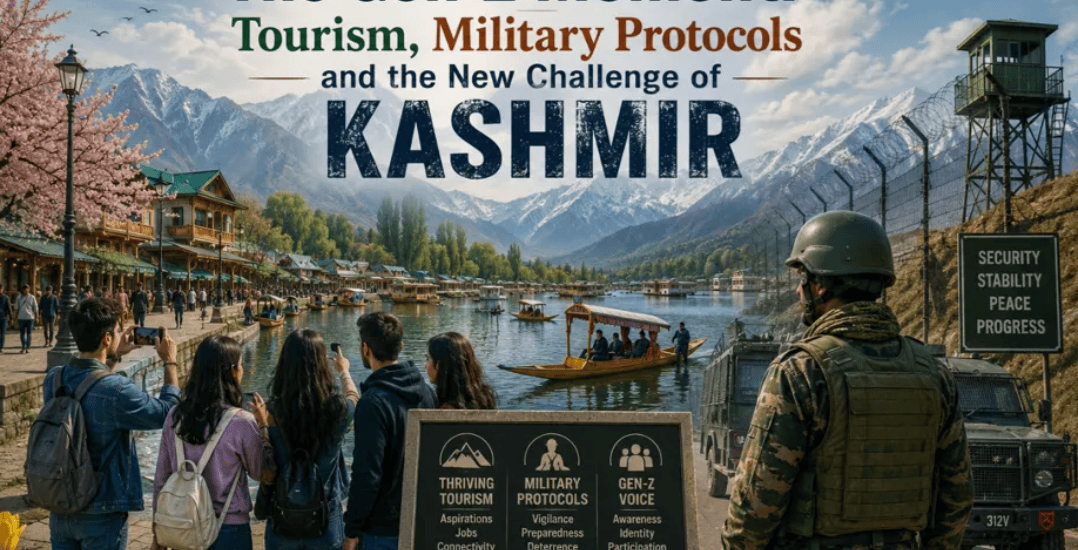
Kargil video may be remembered for a very different reason: as an early warning that the next generation of challenges will not always come from across the Line of Control
PART 1 LINK: https://majgenrajankochhar.substack.com/p/kashmir-at-a-turning-point-sergio?r=6l0juh
The viral video from a checkpoint in the Kargil sector has opened a much larger debate than the incident itself. A young tourist was filmed confronting security personnel at a checkpoint in the Minimarg area and invoking the phrase, “We are Gen-Z,” while objecting to the security procedures. The video rapidly went viral and prompted Jammu and Kashmir Chief Minister Omar Abdullah to comment that such behaviour could erode public goodwill.
The incident should not be dismissed simply as an example of bad manners. Nor should it be transformed into a generational indictment. Most Gen-Z tourists are perfectly capable of behaving responsibly. The deeper issue is something else. A generation accustomed to instant access, individual autonomy, social-media visibility and challenge-based digital culture is entering spaces where military protocols operate according to an entirely different logic. That collision deserves serious attention.
The Tourist Does Not See the Battlefield
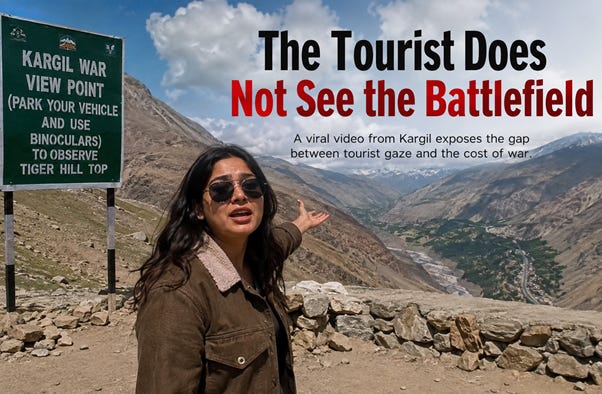
A civilian sees a roadblock. A soldier sees a security perimeter. A tourist sees a delay. A commander sees an unidentified vehicle approaching a sensitive area. A civilian sees a request to stop filming. A security professional may see the possibility that photographs could reveal troop dispositions, convoy timings, weapon systems or infrastructure to hostile intelligence agencies.
This difference in perception is fundamental. In an ordinary tourist destination, questioning a police officer or demanding an explanation may be entirely reasonable. Near a military installation, an operational convoy, a border road or a sensitive checkpoint, the same behaviour can have very different consequences. The problem is therefore not that civilians should surrender their rights. The problem is that civilian rights and military security protocols operate in different risk environments. The solution is better awareness, not confrontation.
Why Civilian Awareness Is Now a National-Security Requirement: Challenges
The traditional model assumed that border populations understood the security environment because they lived with it. Tourism changes that assumption. A traveller arriving from Mumbai, Delhi, Bengaluru or Hyderabad may have no understanding of why a convoy suddenly stops traffic, why photography may be restricted, why identity documents are checked or why a particular road may be closed without explanation.
The tourist may interpret these actions as inconvenience. The soldier interprets them as operational necessity. The gap between these perceptions can create avoidable friction. India therefore needs a civilian-security awareness architecture for border tourism.
This need is becoming more urgent as tourism expands into frontier regions. Ladakh is precisely the example. Tourists are increasingly travelling into areas where the spectacular landscape exists alongside military infrastructure, logistics routes and proximity to contested borders. The more successful tourism becomes, the greater the number of civilians entering spaces where security protocols remain non-negotiable. This produces a paradox. The success of normalcy can increase the security-management burden.
The New Challenge: Tourism Versus National Security
The future challenge in Ladakh and Kashmir will not necessarily be to choose between tourism and security. It will be to make them compatible. That requires planning.
Tourist routes should be clearly classified. Restricted areas should be visibly marked. Photography restrictions should be explained. Checkpoints should have standardised civilian-facing procedures. Tour operators should be required to brief visitors. Hotels and homestays should provide basic security-awareness material. Most importantly, the military should not be expected to conduct every public-awareness function at the checkpoint itself. A soldier’s primary responsibility is mission accomplishment. A tourist’s education about security procedures should happen before the tourist reaches the checkpoint.
A short digital briefing before issuing permits could explain what visitors can photograph, where they may stop, how convoys should be treated, why identification is required and what behaviour is prohibited. This would cost very little. The security dividend could be enormous.
The Social-Media Problem
There is another dimension that is potentially more serious. Every confrontation today has the possibility of becoming content. A decade ago, an argument at a checkpoint might have been witnessed by twenty people. Today it can be filmed, uploaded and viewed by millions within hours. This creates a dangerous incentive structure. The person who behaves provocatively may receive greater attention than the person who behaves responsibly. The result is what might be called performative confrontation.
The objective is no longer merely to win an argument. It can become an attempt to create a viral moment. Military personnel cannot operate according to the logic of social media. They cannot respond to provocation in the same manner as an influencer. The soldier has to maintain discipline, even when being filmed. This places a disproportionate burden on the security forces.
Is “Gen-Z” Becoming a New Form of Entitlement?
This is where the broader question raised by the Kargil episode becomes interesting. Are we seeing the emergence of a generation that uses “Gen-Z” not simply as a demographic description but as an assertion of identity, entitlement and immunity from conventional authority?
There is some evidence in popular culture of a broader phenomenon in which generational identity is used as a rhetorical weapon. But it would be intellectually wrong to conclude that Gen-Z as a whole behaves this way. Generational labels are convenient but crude. The real issue is digital-era individualism.
Many young people have grown up in an environment in which institutions are questioned, hierarchies are challenged, personal expression is celebrated and social-media amplification can convert an individual’s grievance into a public campaign. These are not necessarily negative characteristics. They can produce entrepreneurship, political engagement, innovation and institutional accountability. But transported into a sensitive military environment, the same characteristics can become counterproductive.
The phrase “I am Gen-Z” cannot confer exemption from a security protocol. Nor should being young be treated as an excuse for disrespect. Equally, authorities must understand that younger travellers expect transparency and explanation. The answer lies in firmness combined with communication.
The Army Also Has to Adapt
The lesson is not only for civilians. The military must also adapt to the information environment. A soldier at a checkpoint may be dealing with civilians who have cameras, livestreaming devices and hundreds of thousands of social-media followers. The interaction is therefore potentially public from the moment it begins. Training for personnel deployed in high-tourism border areas should increasingly include civilian interaction, escalation control, media awareness and the handling of provocative filming. This does not mean weakening military authority. It means strengthening it through professional communication. The best checkpoint is not necessarily the one that creates the greatest intimidation.It is the one in which the civilian understands what is required and complies without unnecessary friction.
The Larger Strategic Picture
There is an interesting convergence here. Sergio Gor’s visit is about demonstrating that Kashmir is becoming safe enough for international engagement. The Gen-Z incident demonstrates how difficult it can be to sustain that normalcy at the micro level. One represents the macro narrative. The other represents the ground reality. The two cannot be separated. India may convince Washington that Kashmir is safer. It may persuade international tourists to return. It may achieve record tourist arrivals in Ladakh. But if visitors repeatedly encounter avoidable confrontations at sensitive checkpoints, the perception of normalcy can still be damaged. The international image of a region is ultimately constructed from thousands of individual experiences.
A New Definition of Normalcy
India therefore needs to redefine what “normalcy” means in Jammu and Kashmir and Ladakh. Normalcy cannot mean the absence of soldiers. That would be an unrealistic and potentially dangerous objective in a sensitive border region. Nor can it mean that every civilian movement is unrestricted. A genuinely normal border environment is one in which security measures coexist seamlessly with civilian life. The soldier remains alert. The tourist remains free. The checkpoint remains functional. The procedure remains respectful. The border remains secure. That is the equilibrium India must achieve.
Kashmir’s Next Battle Is for Confidence
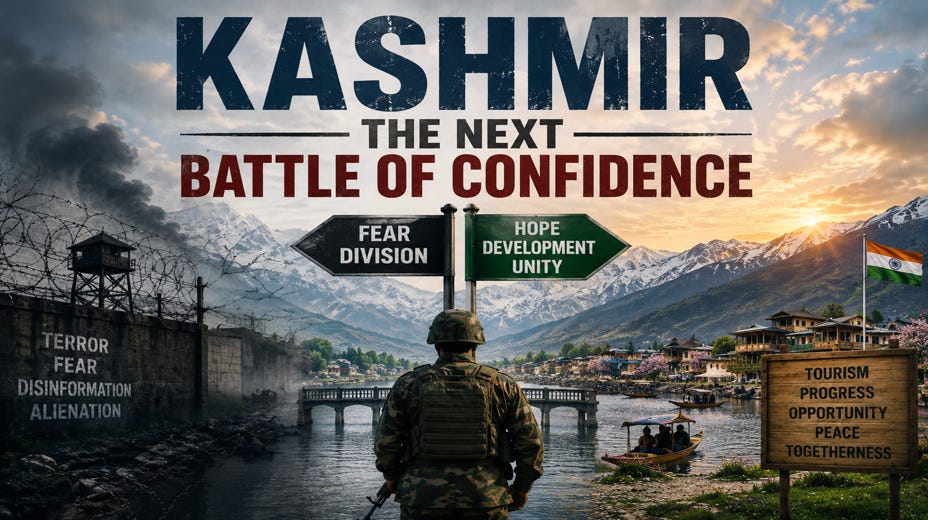
Sergio Gor’s visit has created an important diplomatic opportunity. The United States has acknowledged the changing security environment and signalled that it is prepared to reconsider its travel advisory. Pakistan’s angry reaction demonstrates that Islamabad understands the strategic importance of the statement. India should understand it too. But the real victory will not come from diplomatic statements.
It will come when international tourists routinely arrive in Srinagar, Gulmarg, Pahalgam, Sonamarg, Kargil and Leh without thinking of these places primarily as conflict zones. It will come when American and European travel advisories are progressively aligned with ground realities. It will come when the tourism industry becomes sufficiently confident to invest for the long term. It will come when young Indians travelling to border regions understand that national security is not an obstacle to tourism but the condition that makes tourism possible. And it will come when soldiers and civilians understand each other’s worlds.
The Strategic Choice Before India
India has reached an important inflection point. The security architecture has delivered substantial improvement, even though the threat has not disappeared. Government data shows a dramatic long-term decline in civilian and security-force fatalities from terrorism, while continuing operations against suspected infiltration and terrorist networks demonstrate that vigilance remains essential.
Tourism is recovering. Ladakh’s numbers are particularly encouraging. Washington is reconsidering its travel advisory. An American ambassador has publicly described Jammu and Kashmir as an important part of India. Pakistan is protesting because it recognises the diplomatic implications.The international narrative is therefore moving.But this movement is not irreversible.
India must now consolidate it through governance, development, security, political engagement and responsible tourism. The next phase of Kashmir’s transformation cannot be achieved by security forces alone. It requires the civilian population, tourists, administrators, businesses, political leadership and the military to operate within a common understanding of what the region requires. The central lesson from the Sergio Gor visit and the Kargil Gen-Z controversy is therefore surprisingly similar.
Kashmir is Moving from the Politics of Conflict towards the Politics of Normalcy.
But normalcy itself brings new responsibilities. When a region is insecure, security dominates everything. When a region becomes safer, society begins to demand mobility, tourism, investment, entertainment and individual freedom. That is a sign of progress. But the security environment does not disappear simply because tourism returns.
The challenge for India is to ensure that the transition does not create a false sense of security. The soldier must not become invisible. The civilian must not become unnecessarily restricted. And neither should regard the other as an inconvenience.
The emerging Kashmir model must therefore be one of secure normalcy — a region open to the world, economically vibrant and socially confident, but conscious that it remains a frontier of national security. Sergio Gor’s visit may eventually be remembered as an important diplomatic marker in that transition.
The viral Kargil video may be remembered for a very different reason: as an early warning that the next generation of challenges will not always come from across the Line of Control. Some will emerge from within the success of normalcy itself. And that may be India’s most interesting challenge in the Kashmir and Ladakh of the coming decade.