The Iran Deal Mirage: From Switzerland and Beyond!
- August 1, 2026
- Posted by: Major General (Dr) S B Asthana, SM,VSM,PhD
- Categories: India, Iran, Switzerland, US, USA
The US-Iran Memorandum of Understanding signed in June 2026 and subsequent negotiations in Switzerland have generated cautious optimism. However, beneath the diplomatic headlines lies a deeper strategic reality. In this analysis, Major General (Dr.) S B Asthana examines why the fundamental objectives of Washington, Tel Aviv and Tehran remain irreconcilable, making any future agreement inherently fragile. Drawing upon military strategy, geopolitical realities and regional dynamics, the article explores the JCPOA-plus paradox, the role of Hormuz, the Lebanon fault line, and the implications for India. Sharing the latest analysis from the author.
- Major General (Dr) S B Asthana, SM,VSM,PhD
- June 25, 2026
- Articles/opinion, Defence Strategy and Operational Art, Hybrid Warfare, Internatioanl, International Affairs, Land Warfare, Middle East, Military History and Conflict Studies, Multi Domain Warfare, Publications, Strategic & Defence Analysis, United States
Three Men, Three Timelines, Three Ambitions & One Unresolved War
“Wars end not when missiles stop flying, but when adversaries agree on the future they are prepared to accept. Today, Trump, Netanyahu and Tehran continue to imagine three entirely different futures.”
ExecutiveBranch
AUTHOR’S INTRODUCTION
The US-Iran Memorandum of Understanding signed in June 2026 and subsequent negotiations in Switzerland have generated cautious optimism. However, beneath the diplomatic headlines lies a deeper strategic reality. In this analysis, Major General (Dr.) S B Asthana examines why the fundamental objectives of Washington, Tel Aviv and Tehran remain irreconcilable, making any future agreement inherently fragile. Drawing upon military strategy, geopolitical realities and regional dynamics, the article explores the JCPOA-plus paradox, the role of Hormuz, the Lebanon fault line, and the implications for India. Sharing the latest analysis from the author.
Recommended Reading of Analysis on the subject by the Author: From Asthana Writes (Within website)
► The Iran War & Global Disruption – Interview by FPRC India (Issue 66)
► Hormuz: The Narrow Waterway Holding the World Hostage
► Has Iran Created a TACO Moment for Trump? Decoding Strategies and Limits of Military Power
Recommended Reading of Analysis on the subject by the Author: Other Published Journals
The Iran Deal Mirage: From Switzerland and Beyond
NuclearEnergy
Three Men, Three Timelines, Three Ambitions & One Unresolved War
“Trump wants leverage without occupation, Netanyahu wants dominance without restraint, and Iran wants deterrence without surrender. The danger lies in believing all three can coexist.”
Major General (Dr.) S. B. Asthana, SM, VSM, PhD (Veteran)
The signing of the US-Iran Memorandum of Understanding (MOU) on June 17, 2026, the first round of high-level talks at Lake Lucerne, Switzerland, on June 21-22, and the establishment of four technical working groups mark some forward movement in overly announced MOU, although no written text has been released by any Government so far, despite world media publishing its interpretation depending upon the narrative they are following. Yet four months after Washington and Tel Aviv launched coordinated strikes against Iran on February 28, 2026, amid ongoing nuclear negotiations, the fundamental incompatibility of objectives among the three principal actors remains unresolved. The MOU is an interim stabilisation measure, not a peace agreement. The harder challenge — aligning three structurally irreconcilable political end-states — lies ahead.
A War Without an End State: The Strategic Deficit That Started It All
The original deficiency of this conflict was strategic. The American-Israeli military campaign was launched without a clearly defined political end state or a credible exit strategy. Trump Administration officials may not publicly acknowledge it, but the facts speak clearly: the war commenced during nuclear negotiations, Iran did not pose a direct existential threat to American territory, and the decision to strike was heavily influenced by Israeli Prime Minister Benjamin Netanyahu — an influence that multiple American Presidents had previously resisted. Conversely, for Iran, it was a war for existence which huddled its citizens to resist.
Military
The consequences of that strategic deficit have compounded over four months. Iran has not collapsed, surrendered, or capitulated. The Iranian political system remains intact, and if anything the conflict has strengthened the hardline elements within the regime. Trump now finds himself not asking how to win the war, but how to justify it — and how to exit it before November’s mid-term elections, without a viable exit strategy, which was not thought through earlier. Iran is not providing him that easily. to mitigate the adverse political impact. That is what may be called Trump’s ‘TACO moment’: the limits of coercive diplomacy becoming visible precisely when military power fails to produce desired political outcomes. Trump’s rhetorical threats, announcements fail to acknowledge that having survived, Iran is no mood to give a deal too different than JCPOA of 2015, which will be an election agenda during midterm elections, and not easy to sell to electorate.
The JCPOA-Plus Paradox: What Trump Needs vs. What Iran Will Give
ExecutiveBranch
At the heart of the nuclear negotiations lies an uncomfortable paradox. Trump withdrew from the 2015 Joint Comprehensive Plan of Action (JCPOA) in 2018 on the grounds that it was inadequate. Any new agreement must therefore appear stronger — a ‘JCPOA-Plus’ — or the original withdrawal appears strategically hollow. Yet military realities constrain what Iran can accept. President Trump amidst his rhetoric fails to acknowledge that Iran hasn’t surrendered, hence is under no compulsion to give him JCPOA-Plus, without a significant financial incentive. In 2015, Iran had agreed not to make nuclear bomb, the Strait of Hormuz was open, and IAEA was inspecting facilities.
Now, Iran will not abandon its missile programme. It will not surrender support for Hezbollah and its regional proxies. It will not hand over enriched uranium outright — though Western media and White House have played it that it was willing to consider transfer to a third country. It has no faith in American commitments following the unilateral JCPOA withdrawal and harbours scepticism toward the IAEA, given accusations of information-sharing with Washington. Iranian President Pezeshkian was explicit at Lake Lucerne: ‘We will never back down from the right to enrich uranium.’ Vance’s assertion that Iran has agreed to ‘permanent denuclearisation’ is precisely the kind of framing both sides know is aspirational rather than operational.
The result is a negotiating gap that four months of military pressure have failed to bridge. Any eventual agreement will contain modifications, enhanced verification timelines and implementation mechanisms — but it cannot be dramatically different from the JCPOA framework. That is the uncomfortable strategic reality: Trump requires a JCPOA-Plus politically; Iran has little reason/incentive to deliver one strategically.
Military
Three Leaders, Three Political Timelines
The current crisis remains fundamentally driven by three divergent political timelines, none of which has been resolved by the MOU.
Trump’s timeline is electoral. With mid-term elections approaching and Americans absorbing the inflationary consequences of Hormuz disruption — soaring fuel prices, supply chain stress, and declining approval ratings — Trump’s overriding objective is a deal that can justify military action while avoiding prolonged conflict. The Lake Lucerne talks, led by Vice President JD Vance were conducted with visible urgency towards that cause. Vance one sided announcement that Iran’s agreement to allow IAEA inspectors to return as a ‘major milestone’ although it was part of JCPOA-2015 too but stopped when Iran became suspicious of IAEA passing information to USA. This claim was denied by Iran. This war is an apt example of ‘Narrative War ‘, where one finds President Trump giving out lot of messages meant for his electorates being interpreted as war news by world media!
Netanyahu’s timeline is his political survival, who feels that he can win the next election by being on perpetual war justified by national security narrative over-riding his corruption cases. He along with many hardliners continue to harbour the dream of “Greater Israel” from Jordon River to Mediterranean Sea and have been actively working on it with US support. Unfortunately, as of now Netanyahu’s political ambition of next election is clashing with Trump political survival in the upcoming mid-term elections.
ExecutiveBranch
Israel was neither a party to the Islamabad negotiations, nor to the Lake Lucerne Meeting, yet its actions have repeatedly impacted both. Netanyahu’s advance into southern Lebanon, launched within 24 hours of the MOU signing, nearly collapsed the deal before the ink was dry. His announcement that the Israeli forces will not withdraw from Lebanon and that Israel does not consider itself bound by the Lebanon clause of the MOU — constitutes a direct rejection of a core pillar of the framework. Israel’s security logic is that Hezbollah must be disarmed, will never be agreed by Hezbollah/Iran, and Hezbollah’s and Lebanon’s stance that Israel must withdraw completely out of Lebanon is unlikely to happen notwithstanding diplomatic statements.
Iran’s clock is strategic endurance. Tehran thinks in decades, not electoral cycles. Despite economic devastation, the Iranian leadership has framed the MOU as a victory. Iran’s Lake Lucerne delegation was categorical: Iran will not surrender enrichment rights. Iranian Parliament Speaker Qalibaf insisted that Hormuz remains under Iranian management and will follow ‘international laws’ — language that asserts sovereignty rather than concedes leverage. Iran has secured a 60-day oil sanctions waiver from the US Treasury, a deconfliction mechanism, and the promise of a $300 billion reconstruction framework, subject to certain conditions. Whether it will comply with IAEA inspection demands in future, remains to be seen.
The Islamabad MOU: A Ceasefire, Not a Settlement
The 14-point MOU, mediated by Pakistan (with Qatar’s support), constitutes an interim framework rather than a comprehensive agreement. Its core elements are significant but fundamentally provisional: an immediate and permanent termination of military operations on all fronts including Lebanon, the reopening of the Strait of Hormuz toll-free for 60 days, the lifting of the US naval blockade, Iran’s reaffirmation not to acquire nuclear weapons has been given in the American release (Not confirmed by Iran), and a 60-day window for technical negotiations on enrichment, inspections, sanctions, and reconstruction.
Military
The structural weaknesses of the MOU are equally apparent. Iran’s ballistic missile programme is explicitly off the agenda. Iran’s network of regional proxies — Hezbollah, the Houthis, militias in Iraq and Syria — is not addressed. The Lake Lucerne talks established four working groups: Sanctions Termination, Nuclear Affairs, Reconstruction and Economic Development, and Monitoring and Implementation. But the creation of committees is not resolution. The hardest issues — enrichment caps, stockpile disposition, verification protocols, and the fate of Hormuz’s Persian Gulf Strait Authority — remain for the technical phase of negotiation.
Most critically, the Lebanon fault line remains open and bleeding. An American-Iranian understanding cannot automatically deliver Israeli compliance, nor can it guarantee Hezbollah’s restraint. The ‘Lebanon de-confliction cell’ established at Lake Lucerne represents an acknowledgement of this structural gap rather than its resolution. Iranian Foreign Minister Araghchi described it as the ‘first real test’ of the agreement — and he is right.
Hormuz: Leverage, Deterrence, and the Asymmetry Using Terrain Friction

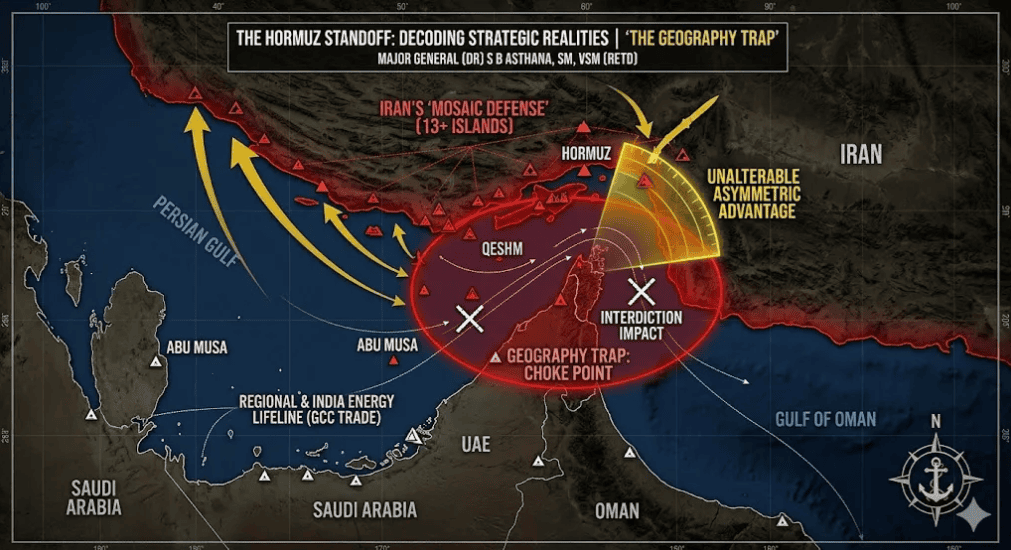
If military strength alone determined outcomes, Iran would already have been defeated. The durability of Tehran’s position rests on one decisive asymmetric advantage: the Strait of Hormuz, through which approximately one-fifth of global oil trade flows. Iran cannot defeat the United States conventionally, but it can impose disproportionate costs on the global economy relative to its own capabilities. The use of terrain friction has defined Iran’s entire negotiating leverage since February 28.
Military
The periodic closure of Hormuz — and its selective reopening under the MOU’s 60-day framework — has demonstrated both the coercive power and the inherent fragility of this leverage. Iran’s newly established Persian Gulf Strait Authority, requiring 48-hour advance notices and special insurance for passage, represents a sovereignty assertion that Washington and all global maritime operators will resist. The IRGC’s announcement on June 21 of a renewed strait closure in response to Israeli strikes in Lebanon — even as Lake Lucerne talks were underway — illustrated precisely how volatile this leverage point remains. For Tehran, Hormuz is not merely a waterway. It is a bargaining chip, a deterrence instrument, and one of the few tools that compels global attention regardless of Iranian economic weakness.
These dynamics are real for India. In June 2026, three US strikes on commercial tankers carrying Indian crews in about four days resulted in the deaths of three Indian sailors in the Gulf of Oman, straining the strategic partnership between both countries. Stable energy supplies and continuous marine trade across the Red Sea and Hormuz are vital to India’s economic growth. Increases in gasoline prices, inflationary pressure, and transportation costs are all strongly correlated with disruptions. New Delhi’s diplomatic challenge — balancing strategic partnerships with Washington while protecting sovereign commercial interests and its diaspora at sea — has become markedly more complex, where Indian diplomacy is seen to be too soft on Trump Administration and has received well deserved criticism in India.
Why Lebanon and East Jerusalem Matter More Than Washington Understands?
One of the most persistently misunderstood aspects of the negotiations is Iran’s insistence on linking Lebanon — and the condition of Israeli withdrawal from southern Lebanon — to any broader settlement. Western commentary has frequently treated this as ideological posturing. It is not. The linking of Palestinian rights to East Jerusalem, has historical, religious and emotional context which can’t be resolved by typical Trump’s deal. Likewise, Lebanon issue too predates the initiation of current war by USA and Israel and may not end with it.
ExecutiveBranch
For Tehran, Hezbollah is neither an independent actor nor merely a proxy. It is a critical component of Iran’s forward defence architecture, creating distributed deterrence across Lebanon, Iraq, Syria, and Yemen. Iran cannot reassure its regional network of allies if Hezbollah appears abandoned under diplomatic pressure.
The Lebanon issue also predates the current conflict and will outlast any bilateral MOU between Washington and Tehran. The opinion of people of Lebanon is divided wherein half of them feel Hezbollah as nuisance and cause of trouble to them and the other half views Hezbollah as saviour as their politicians and weak defence forces are incapable of defending them from Israel.
Israel’s position is equally structurally fixed. Netanyahu has told Trump unambiguously that Israeli forces will not withdraw from Lebanon. Lebanon remains the fault line upon which broader diplomacy may ultimately succeed or fail.
The Illusion of Controlled Escalation — and the Real Danger
Perhaps the gravest danger in the current environment is the shared assumption among all three actors that escalation can remain calibrated. Trump appears to believe targeted military pressure can compel negotiation without triggering regional war. Netanyahu appears to believe sustained military operations will eventually reshape the strategic environment in Israel’s favour. Iran appears to believe asymmetric responses can impose sufficient costs to ensure regime survival while preserving its deterrence ecosystem.
ExecutiveBranch
History offers little comfort to any of them. Escalation ladders rarely conform to theoretical models. A miscalculation in Hormuz, a strike on critical energy infrastructure, a major casualty event involving regional actors, or an unintended naval clash could rapidly internationalise the conflict beyond the 60-day diplomatic window. Iranian counteraction options of sea cables, closing Red Sea and further strikes on regional allies are known responses representing dangerous, but realistic trajectory, if the 60-day technical process collapses. West Asia today is a complex ecosystem of states, proxies, militias, energy routes, undersea infrastructure, and competing national narratives. Such environments are inherently resistant to controlled escalation. The confidence of U.S. regional allies stands shaken up and ongoing Rubio’s visit may not be adequate to restore it.
A Provisional Assessment: What the 60-Day Window Must Deliver
The Lake Lucerne summit has produced a framework — four working groups, a road map, a deconfliction line — but frameworks are not agreements. The 60-day technical phase have tougher waters to navigate like Iran’s enrichment rights, IAEA inspection authority and scope, the disposition of enriched uranium stockpiles, phased sanctions relief verification, the $300 billion reconstruction framework, and the Lebanon ceasefire mechanism. Each of these issues is individually complex. Their interaction makes the challenge exponentially more difficult.
Arabs& Middle Easterners
The world should focus less on announcements and more on implementation/outcomes. The real challenge is not signing agreements; it is aligning fundamentally incompatible political objectives. Trump seeks a deal that justifies past coercion and forestalls electoral damage. Netanyahu’s strategy resists the compromise such a deal requires. Iran’s strategy depends on retaining precisely the capabilities — missiles, proxies, Hormuz leverage — that Washington and Jerusalem seek to curtail.
Wars end not when missiles stop flying, but when adversaries agree on the future they are prepared to accept. Today, four months into a conflict that was launched without a political end state, Trump, Netanyahu, and Tehran continue to imagine three entirely different futures. Until the divergence in political end-states is bridged — not papered over — every ceasefire will remain provisional, every agreement fragile, and every declaration of progress vulnerable to the next round of escalation.
─────────────────────────────────────────
Major General (Dr.) S. B. Asthana, SM, VSM, PhD (Veteran)
(The views expressed are personal views of the author, who retains the copy right. The author is a Globally acknowledged Strategic and Security Analyst, He can be reached at Facebook and LinkedIn as Shashi Asthana, @asthana_shashi on twitter, and personnel site https://asthanawrites.org/ email shashiasthana29@gmail.comLinkedIn Profile www.linkedin.com/in/shashi-asthana-4b3801a6. Youtube link https://www.youtube.com/@GenAsthanaAnalyses
Military