BIMSTEC at thirty: Renewed challenges, new opportunities
- July 14, 2026
- Posted by: Anil Trigunayat
- Categories: Bangladesh, India, Southeast Asia, Sri Lankan, Thailand
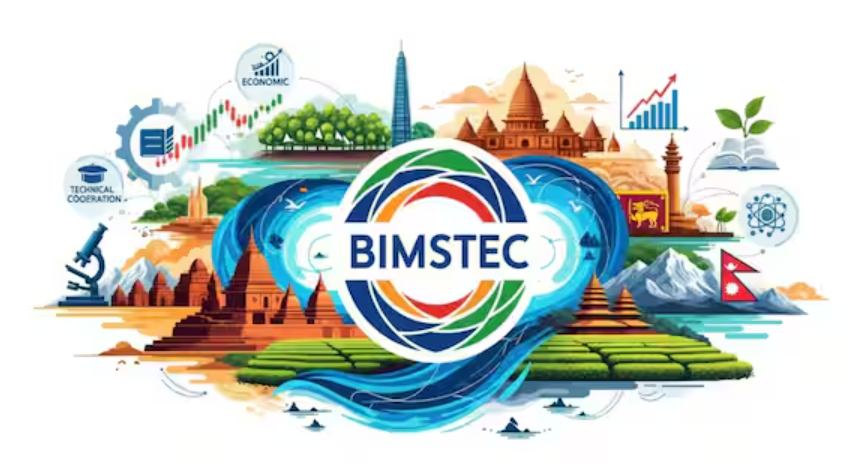
In the era of technological supremacy and the corresponding digital divide, BIMSTEC has significant potential to become a digitally integrated regional economy linking South Asia and Southeast Asia
The Bay of Bengal Initiative for Multi-Sectoral Technical and Economic Cooperation (BIMSTEC) was born out of the Bangkok Declaration in 1997. Initially, it was known as BIST-EC, with only Bangladesh, India, Sri Lanka and Thailand as members. Subsequently, Bhutan, Myanmar and Nepal joined, giving it the deep strategic character that encompasses the giant Bay of Bengal, from the heights of the Himalayas to the depths of the Indian Ocean. But, like many of its ilk in the regional collaborative matrix, deeper and smoother integration has still eluded it for various reasons, even though the BIMSTEC Secretariat was established in Dhaka in 2014, with the largest funding provided by New Delhi. Finally, a BIMSTEC Charter was adopted in 2022, providing it with a new orientation and concrete goals.
STORY CONTINUES BELOW THIS AD
There is no dearth of arguments for the slow pace of integration, ranging from a lack of trust, differing levels of development, economic differentials, and the non-availability of working capital and project funding. But perhaps the greatest responsibility lies with political will among regional leaders and prevailing, and increasingly accentuated, geopolitics, since several other choices and options distracted them. So far, only six summits have taken place in thirty years. The last was held in Bangkok in 2025, when Vision 2030 was adopted and Prime Minister Narendra Modi also advanced a 21-point action plan. The next summit is expected to be held in Dhaka, possibly in 2027.
More from Opinion
Even though it is better connected than SAARC, the lack of connectivity remains well beyond acceptable limits for deeper integration. Like any other organisation, often hoary ideals, loud aspirations and expansive outreach tend to thin out the core, and hence outcomes are usually below expectations, casting doubts on its efficacy and purpose. The blame game becomes the lingua franca. BIMSTEC is no exception, even though its intra-regional trade of about seven per cent is a shade better than that of SAARC, but only around one-third, or even one-fourth, of that of its peer grouping, ASEAN. Initially, BIMSTEC had some fourteen verticals for enhancing cooperation, which were subsequently rationalised into a more realistic seven, with each country undertaking a specific sectoral responsibility. These include trade, investment and development—Bangladesh; environment and climate change—Bhutan; security—India; agriculture and food security—Myanmar; people-to-people contact—Nepal; science, technology and innovation—Sri Lanka; and connectivity—Thailand.
Ironically, two important initiatives for trade and connectivity have remained incomplete exercises for over two decades. These include the BIMSTEC Free Trade Agreement and the Master Plan for Transport Connectivity, which has so far been ratified only by New Delhi. While issues relating to trade patterns, complementarities and differences in economic size remain hurdles for the FTA, the transport connectivity endeavour is afflicted by trust and capacity constraints among other members. As such, India has preferential trade agreements with BIMSTEC countries except Bangladesh and Myanmar, in addition to instruments such as SAFTA and the India-ASEAN FTA, which cover the remaining two. One observer from a landlocked member state aptly remarked: “You want us to participate in a horse race when we have never ridden a horse.”
India is the largest country, economy, democracy and military power in the grouping, with regional and global ambitions. But Asia is her Karmabhoomi, and hence it is perhaps time that New Delhi develops a holistic “Asia First Policy” within which several sub-regional and sectoral initiatives could be embedded. Given the economic differential and geostrategic necessity, it is no wonder that India has to do the heavy lifting in this unique neighbourhood geography. It has taken umpteen initiatives across domains to keep the momentum going, and the list is long. Moreover, New Delhi’s non-reciprocal Neighbourhood First Policy for South Asia and Act East Policy for Southeast Asia blend naturally within BIMSTEC, alongside India’s North Eastern regional development mission and MAHASAGAR (Mutual and Holistic Advancement for Security and Growth Across Regions).
Since 2014, India has taken the lead in galvanising BIMSTEC, and the out-of-the-box invitation by PM Modi to BIMSTEC leaders at the BRICS retreat in Goa in 2016 was a unique experiment. This year too, India is hosting the BRICS Summit, while several events for BIMSTEC youth exchanges and cultural connectivity are being organised.
While other initiatives are en route, in this era of technological supremacy and the corresponding digital divide, BIMSTEC has significant potential to become a digitally integrated regional economy linking South Asia and Southeast Asia. Digital connectivity and cross-border digital trade are increasingly important for achieving deeper economic integration among its member states. This is particularly important because physical connectivity and ease of travel still defy logic, dampening efforts at connectivity, people-to-people contact, tourism and hospitality cooperation.
An expanding digital market has enormous potential. BIMSTEC countries collectively represent over 1.7 billion people, creating a large market for digital goods and services. Growth in e-commerce, digital payments, online education, telemedicine and IT-enabled services can boost regional trade. Small and medium enterprises (SMEs) can access wider regional markets through digital platforms. India, being an acknowledged knowledge power and economy, has the requisite heft, although building digital trust will be essential, as concerns over digital sovereignty are sometimes necessary but occasionally misplaced due to a stone-age mindset.
STORY CONTINUES BELOW THIS AD
Since India, Sri Lanka and Thailand have, directly or indirectly, been entrusted with related pillars, an IST working group could examine and advance plurilateral initiatives. Innovation and “INDOVATION” could lead the way as culture, connectivity—digital, physical and spiritual, collective security, and shared prosperity drive integration. The Unified Payments Interface (UPI), space cooperation, energy cooperation and a pan-BIMSTEC digital network, similar to initiatives in Africa, could further advance regional integration for mutual benefit.
BIMSTEC has an Ambassadors’ Standing Group which steers and monitors progress on projects and initiatives, particularly those emerging from summit decisions. It could be entrusted with the task of continuously addressing contentious issues with their own governments and with governments in their countries of accreditation while collaborating with the BIMSTEC Secretariat, industry, academia and youth through regional platforms to generate concrete outcomes. This could be achieved through continuous SWOT analysis, even as ministerial meetings and working groups continue with their respective responsibilities.
STORY CONTINUES BELOW THIS AD
India recently hosted the President of Myanmar and the new Foreign Minister of Nepal. While speaking at the Sapt-Sur BIMSTEC Music Festival and on BIMSTEC Day, External Affairs Minister S Jaishankar reiterated India’s commitment to BIMSTEC, tweeting that “BIMSTEC is advancing shared prosperity, connectivity and resilience across the Bay of Bengal region. India reaffirms its commitment to deepening collaboration with fellow BIMSTEC states in the spirit of solidarity and mutual cooperation.”
The proof of the pudding is in the eating, but all actors must have a seat at the table.
(Anil Trigunayat is a former Indian ambassador to Jordan, Libya and Malta and a distinguished fellow and head of the West Asia Experts Group at the prestigious Vivekananda International Foundation. He is also a Distinguished Fellow at the oldest Indian think tank, the United Services Institution of India. Views expressed in the above piece are personal and solely those of the author.