
Pakistan’s Broken Grid: How Chinese Solar Panels Are Rewiring a Failing Nation
- June 18, 2026
- Posted by: admin
- Categories: China, Pakistan
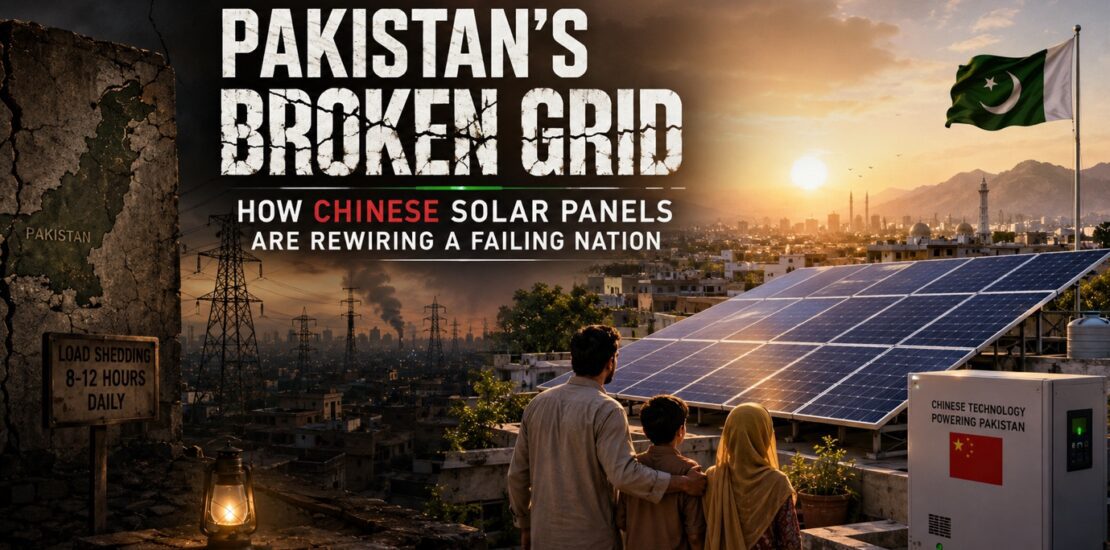
Chinese solar panels have quietly triggered a small energy revolution in Pakistan — but one that is unfolding largely outside the formal state electricity system. In many ways, solar energy has become an escape route for ordinary Pakistanis frustrated by blackouts, soaring tariffs, and the dysfunction of the national grid.
Over the past few years, Pakistan has witnessed an explosive increase in imports of low-cost Chinese solar panels, batteries, and inverters. Falling global solar prices — driven mainly by China’s massive manufacturing scale — have made rooftop solar systems affordable for Pakistan’s urban middle class, factories, shops, farms, and even rural households. Entire markets in cities such as Lahore, Karachi, and Peshawar are now dominated by Chinese solar equipment.
Between 2021 and 2025, Pakistan went from importing roughly 2.5 GW of Chinese solar panels annually to more than 16 GW — one of the fastest solar adoption surges anywhere in the world. By late 2025, the country had imported over 50 GW of Chinese solar panels — nearly equivalent to the country’s entire conventional power generation capacity.
The impact has been substantial.
First, solar energy has reduced dependence on the unreliable national grid for thousands of consumers. Homes and businesses that once suffered 8 to 12 hours of load shedding now use rooftop solar systems to power fans, lights, air-conditioners, tube wells, and commercial operations. In many affluent urban neighbourhoods, solar panels have dramatically reduced the daily disruption caused by power cuts.
Second, solar adoption has helped many consumers escape Pakistan’s punishing electricity tariffs. With electricity prices rising sharply under reforms pushed by the International Monetary Fund, consumers have increasingly turned to solar as a form of economic self-defence. For many households, the upfront investment in solar panels pays for itself within a few years through lower electricity bills.
Third, the agricultural sector has benefited significantly. Farmers in Punjab and Sindh increasingly use solar-powered tube wells for irrigation instead of relying on expensive diesel pumps or unreliable grid electricity. This has reduced fuel costs and provided greater energy independence in rural areas.
Industries and small businesses have also embraced solar energy to maintain operations during outages. Textile factories, shops, restaurants, and offices now frequently install hybrid systems combining solar panels with batteries and generators. In a country where electricity uncertainty undermines productivity, solar power offers predictability.
Perhaps most importantly, solar energy has partially decentralised Pakistan’s energy landscape. Citizens are no longer entirely dependent on the state-run electricity system. In some neighbourhoods, rooftop solar installations are now so widespread that daytime demand on the grid has fallen noticeably.
Yet despite these benefits, solar energy has not solved Pakistan’s overall power crisis.
The biggest limitation is inequality. Solar systems remain affordable mainly for the middle and upper classes, large businesses, and wealthier farmers. Millions of poorer Pakistanis living in urban slums and remote rural areas still cannot afford the initial installation costs. As a result, an energy divide is emerging in which wealthier citizens “exit” the dysfunctional grid while poorer consumers remain trapped inside it.
This creates a dangerous financial problem for Pakistan’s electricity sector. As affluent consumers reduce their dependence on the grid through solar power, the government loses some of its highest-paying customers. The burden of maintaining the national electricity system then falls increasingly on fewer consumers, driving tariffs even higher. Economists warn this could create a “utility death spiral,” where rising prices push even more people toward private solar systems.
Another problem is the lack of adequate battery storage. Most rooftop systems function efficiently during daylight hours but still depend on the national grid or generators at night unless expensive battery backups are installed. Pakistan also lacks a modern smart-grid infrastructure capable of efficiently integrating large amounts of decentralised solar power into the national system.
Pakistan’s solar boom depends overwhelmingly on Chinese manufacturing dominance. Even as Pakistan struggles with foreign exchange shortages, it continues importing vast quantities of Chinese solar equipment because domestic manufacturing remains extremely limited.
Nevertheless, the spread of Chinese solar panels has provided one of the few genuinely positive developments in Pakistan’s troubled energy sector. In many areas, citizens have effectively begun creating a parallel electricity system independent of the state’s failures.
The long-term challenge for Pakistan is whether it can transform this scattered rooftop revolution into a coherent national energy transition. If managed intelligently, solar energy could reduce fuel imports, lower carbon emissions, ease pressure on the grid, and improve energy security. But if policymakers continue with short-term thinking and regulatory confusion, solar adoption may simply deepen inequality while leaving the underlying structural crisis unresolved.
For millions of Pakistanis today, however, the conclusion is already clear: when the state could not provide electricity, the sun — and cheap Chinese panels — stepped in.