30 DAYS OF WAR: TRACKING THE WEST ASIA CONFLICT
- April 21, 2026
- Posted by: Shashwat Ranjan
- Categories: Israel, US, West Asia
By Shashwat Ranjan
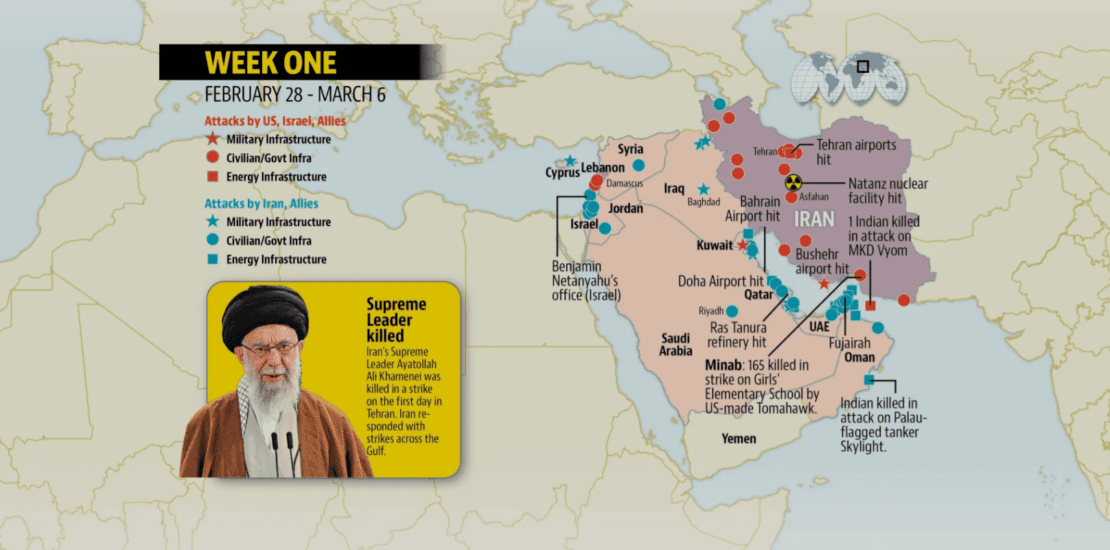
Over the past 30 days, West Asia has been engulfed in a regional war triggered by Operation Epic Fury and Operation Roaring Lion. This joint US-Israeli campaign began with “decapitation strikes” in Tehran that killed Supreme Leader Ali Khamenei and much of Iran’s senior military and political leadership.
But what was initially framed as a swift move toward regime change has instead spiralled into a global crisis after Iran choked the Strait of Hormuz, through which 20% of the world’s oil moves, and Israel attacked Iranian energy facilities, prompting Iran to attack oil and gas infrastructure across the Gulf, creating a global energy shock that has seen oil prices rise by as much as 45%. The conflict widened further when Yemen’s Iran-aligned Houthi movement entered the war in the fourth week, targeting Red Sea shipping and raising fears that the Bab al-Mandab strait — another vital artery linking the Indian Ocean to the Mediterranean via the Suez Canal — could emerge as a second global maritime chokepoint alongside Hormuz.
The US’s allies, North Atlantic Treaty Organization (Nato) and non-Nato, pushed back against the Trump administration’s requests to join the kinetic theatre and criticised the war. Criticism mounted further as US President Donald Trump and senior US officials repeatedly shifted their explanations for the war’s purpose, duration and endgame.


Shock and decapitation strike
The conflict began on February 28 when the United States and Israel launched a massive air assault on Tehran, killing Supreme Leader Ayatollah Ali Khamenei and many top Iranian officials. The US-Israeli strikes also targeted over 1,000 sites across Iran, including military facilities.
While Khamenei’s killing violated international conventions against targeting a head of state or government, and set a dangerous new precedent in international relations, US President Donald Trump framed the attacks as necessary to prevent Iran from developing nuclear weapons, stop its missile programme, and push for regime change. He openly called on Iranians to rise up and overthrow their government, calling it a “once-in-a-generation” opportunity.
The opening salvo also attacked nuclear infrastructure, such as the Natanz Nuclear facility.
The human cost: Minab school strike
On February 28, during the initial wave of “Operation Epic Fury,” a strike levelled the facility in southern Iran, killing at least 165 people. Most of the victims were young students in the school located adjacent to an Iranian Revolutionary Guard Corps (IRGC) compound.
The destruction of a girls’ elementary school in Minab stands as the conflict’s most harrowing humanitarian disaster and triggered a massive shift in global public opinion, sparking protests from Asia to Europe.
Independent analysis by international media and research groups also identified the weapons used as US Tomahawk cruise missiles.
Iran’s retaliation: Regional targets
Some Iranians celebrated Khamenei’s death, but millions turned out for his funeral.
Iran called the attacks unprovoked acts of war and retaliated with strikes on countries in West Asia hosting US military bases — UAE, Kuwait, Qatar, Bahrain, Saudi Arabia and Lebanon — and Israel on February 28 and March 1. Civilian infrastructure was not spared, with Gulf governments saying that residential and government infrastructure was damaged, largely from falling debris after missile and drone interceptions.
Attacks on airports, landmark Gulf sites
On March 1, Iran targeted a hotel in Erbil, Iraq that was housing US troops. It later targeted the US embassy compounds in Riyadh, Saudi Arabia and Kuwait.
Tehran targeted airports across the Gulf region, with missiles and drones either striking the premises or infrastructure or nearby facilities of Dubai and Abu Dhabi airports, and the Baghdad airport and an airport in Azerbaijan.
Also hit were residential sites, including Dubai’s The Palm and Palm Jumeirah. Explosions rocked the Palm Jumeirah man-made island, and drone debris caused a fire at the Burj Al Arab ultra-luxury hotel.
The Maritime blockade: Strait of Hormuz
But it was Iran’s decision to restrict traffic through the Strait of Hormuz, the narrow maritime corridor linking the Persian Gulf to global markets, that the world acutely felt the impact of the conflict as energy prices surged. Iran enforced the blockade, attacking oil tankers in the Persian Gulf and around the Strait of Hormuz.
On March 1, the Palau-flagged tanker Skylight was struck by a projectile off the coast of Oman, reportedly by Iranian fire. The ship’s captain, an Indian national, Ashish Kumar, was killed. A second Indian, Dalip Singh, is still missing. On the same day, Gibraltar-flagged Hercules Star was struck at anchorage near Fujairah by an unknown projectile.
At least eight more crude tankers and bulk carriers were attacked in the region. The MKD Vyom, Athe Nova and Stena Imperative were struck on March 2. MKD Vyom’s oiler, Solanki Dixit Amratlal, died in the attack. Gold Oak and India-flagged Libra Trader were hit on March 3, Safeen Prestige on March 4, killing two port workers, and Sonangol Namibe on March 5. On March 6, Massafah-2 was attacked, in which several crew members were killed. Some of the ships were attacked while transiting the strait, while some were struck while at berth.
Iran also attacked oil refineries in Kuwait, Saudi Arabia, key ports in the UAE and Oman. The US did not attack Iranian oil infrastructure in response to avoid a severe global spike in oil prices, and limit Iranian retaliation against other key Gulf energy and water infrastructure.
Commercial shipping slowed dramatically as insurers withdrew coverage for vessels transiting the strait, and shipping companies rerouted vessels to avoid risk.
Sea freight rates rose by up to 300%, while air freight rates also rose by 70% on some routes, with rates on routes between South Asia and Europe the most affected. Hundreds of ships were anchored or drifting in the Persian Gulf, unable to transit the Strait of Hormuz due to security concerns.
Indian vessels stranded
As Iran closed off the Strait of Hormuz, at least 24 Indian flagged commercial vessels were stranded in the Persian Gulf west of the strait, along with scores of foreign-flagged vessels carrying cargo to India. Over the following weeks, India would move to diversify its energy imports and reduce exposure to the strait. The Indian government also began rationing commercial supplies, with 90% of LPG supplies relying on passing through the strait.
Gulf air travel halts, 15,000 flights grounded
Between February 28 and March 7, air travel collapsed as major airports in several countries in the region shut down, grounding over 15,000 flights in the first week alone. Flight maps showed skies over Iran, Iraq, Kuwait, Israel and Bahrain virtually empty, while airlines across Europe and West Asia announced sweeping cancellations, though international hubs such as Dubai and Abu Dhabi managed to continue partial operations amid intermittent attacks.
India has more than 10 million of its nationals in West Asia. More than 52,000 Indians returned on commercial flights during the first week. At least 32,107 of them returned on Indian carriers. Many students undergoing higher studies in Iran were also stranded in the country.
Iranian naval vessel sunk in Indian Ocean
On March 4, the Iranian navy ship IRIS Dena was sunk by a US torpedo, approximately 40 nautical miles off the coast of Galle in Sri Lanka. Dena had left India after participating in a joint naval exercise and a port visit at India’s invitation. The Indian Navy deployed ships and aircraft to assist in the Sri Lanka-led search-and-rescue operations.
Of the estimated 180 crew members on board, over 80 sailors were reported dead. India gave safe harbour to the Iranian vessel IRIS Lava in Kochi, after a request from Iran. Bodies of some of the deceased sailors from Dena were repatriated to Iran, but many of the rescued sailors remain in protective custody in Sri Lanka.
Lanka denies US request to land warplanes
Sri Lanka said it refused permission to the US to station two warplanes at a civilian airport in the island’s south. The US wanted to bring two warplanes armed with eight anti-ship missiles from a base in Djibouti to Mattala International Airport from March 4 to 8. Sri Lankan President Anura Kumara Dissanayake said the US made the request on February 26, the same day Iran asked for three of its warships returning from India after a naval exercise to make a port call.
Netanyahu’s office targeted
Amid the initial wave of strikes, Iranian missiles also targeted the office of Israeli Prime Minister Benjamin Netanyahu and the headquarters of the Israeli air force commander on March 2.
3 US jets downed in ‘friendly fire’
The US military said seven service members were killed and another four seriously wounded in Iran’s initial retaliation in an attack on a makeshift operations centre at a civilian port in Kuwait on March 2. The day before, three US warplanes were also shot down, but the US claimed that they were shot down by Kuwait air defences in friendly fire.
Lebanon front opens after Iranian allies retaliate
On March 2, Hezbollah retaliated against Israel for Khamenei’s death by firing on the country. In response, Israel extended the war into Lebanon, targeting Beirut and forcing a massive evacuation of 300,000 people, many fleeing into the streets, cars, and even onto beaches with no shelter.
Yemen’s Houthi movement, long aligned with Iran and previously active against Red Sea shipping, did not enter the war.
The human toll mounted. By the end of the week, at least 1,230 people had died in Iran, 123 in Lebanon, and at least 10 Israelis, with many more wounded.
Trump demands unconditional surrender
While there were signs of diplomacy — Iran’s acting president, Masoud Pezeshkian, announced that some countries had begun mediation efforts — Trump escalated his demands dramatically, calling for Iran’s “unconditional surrender” on social media. He said the US and its allies would help select Iran’s next supreme leader, further intensifying the conflict.


War hits the world economy
By the second week, the conflict had evolved from a military confrontation into a crisis reshaping global trade, energy security and regional stability.
On March 12, oil prices touched $100 a barrel, and stocks worldwide skidded amid worries of a protracted disruption to oil markets. It was the largest one-day jump for Brent since May 2020 and the first time it has closed above $100 since 2022. The International Energy Agency said the closure of the Strait of Hormuz had triggered the largest disruption to global oil markets in history and moved to release a record 400 million barrels of oil from its member countries’ emergency strategic reserves.
Iran: A new Supreme Leader
Iran announced on March 8 that it had selected Ali Khamenei’s son, Mojtaba Khamenei, as the new Supreme Leader. On March 2, Israel had struck the building housing the Assembly of Experts in Qom, which comprises clerics who select Iran’s Supreme Leader.
Nuclear facility targeted
On March 12, Israel targeted the Parchin nuclear complex southeast of Tehran, saying it was used in an alleged Iranian nuclear weapons programme. Iranian missile and drone launches continued intermittently toward Israeli territory and regional targets.
US waiver for Russian oil
On March 12, the US issued a 30-day waiver for countries to buy sanctioned Russian oil and petroleum products currently stranded at sea — the same waiver US granted India on March 5 — in an effort to stabilise global energy markets after the US and Israeli strikes on Iran paralysed shipping through the Strait of Hormuz.
First India-bound vessel transits Hormuz
On March 11, a Liberia-flagged tanker, Shenlong, carrying Saudi crude, reached Mumbai Port, becoming the first India-bound vessel to pass through the Strait of Hormuz since the war began. The tanker had loaded crude from Ras Tanura port in Saudi Arabia on March 1 and departed on March 3.
Gulf cities face the brunt of attacks
Iran kept up attacks on infrastructure across the Gulf. It targeted Dubai Airport, the world’s busiest international airport, and Bahrain’s international airport on Muharraq Island. An Iranian drone also struck a luxury apartment tower in Dubai Creek Harbour, sparking a fire. Iran also continued attacking commercial ships in the Persian Gulf. It also attacked industrial areas in Saudi Arabia, Bahrain, Kuwait and Oman. Iran again targeted the US embassy compound in Baghdad.
Over 350,000 stranded Indians return
By the end of the second week, more than 1,043 Indians, including 717 students, who were stranded in Iran, crossed to Armenia and Azerbaijan and then returned safely to India on commercial flights. There were no direct flights due to airspace closures over the conflict in West Asia.
Water infra targeted for first time
Iran struck a water desalination plant in Bahrain on March 8 after a US strike on a water desalination plant on Qeshm Island. Iran said the US attacked Qeshm from a base in Bahrain.
West Asia is among the driest regions in the world, with water availability about 10 times lower than the global average, according to the World Bank. That makes desalination plants essential to the region’s economy and drinking water supplies. About 42% of the world’s desalination capacity is located in West Asia, according to a study published in Nature. Desalinated water provides 42% of drinking water in the UAE, 70% in Saudi Arabia, 86% in Oman and 90% in Kuwait, according to a 2022 report from the French Institute of International Relations think tank.
More Indians killed on land and sea
On March 12, Safesea Vishnu was struck by an Iranian vessel off Khor Al Zubair Port, near Basra, Iraq. Its additional chief engineer (superintendent), Deonandan Prasad Singh, was killed, while the remaining 27 crew (16 Indians and 12 Filipinos) were rescued. On March 13, two Indian nationals were killed, and 10 were injured in a drone strike in an industrial area in Oman, marking the first Indian fatalities on land in a West Asian country since the start of the war.
More vessels were attacked in the Gulf. On March 11, the Mayuree Naree, Star Gwyneth and One Majesty, on March 12, aside from Safesea Vishnu, the Zefyros and Source Blessing.
US refuelling tankers collide in mid-air
On March 13, six US service members were killed when two American KC-135 tankers collided in Iraq. Military officials said that American refuelling tankers were rushed into the war with little time to orient themselves or practice in the region before being thrown into round-the-clock operations.
Escalation: Attack on Kharg Island
On March 13, the US carried out strikes to destroy military sites on Kharg Island, which handles 90% of Iran’s oil exports. The strike didn’t impact the island’s oil infrastructure, but Trump later threatened that the island would be targeted again — even its oil infrastructure — “just for fun”.
An attack on Kharg Island could risk choking off much of the world’s oil supply, since Iran has threatened to attack the Gulf’s energy infrastructure if any of its oil facilities are attacked.


US orders more troops to region
Three weeks into the conflict, and following the attack on Kharg Island, the US signalled another escalation. It ordered a major deployment to the region, sending an Amphibious Ready Group (ARG) led by the USS Tripoli from Japan, along with 2,500 Marines from the 31st Marine Expeditionary Unit, as part of its own strike group, to West Asia.
On March 20, US officials said that the USS Boxer and two other amphibious assault ships, along with 2,500 Marines of the 11th Marine Expeditionary Unit, had also been deployed to West Asia.
The move came as Washington struggled to reopen the Strait of Hormuz, and experts indicated that the reinforcements could be a prelude to a ground assault.
Trump seeks help, allies say no
The strait’s closure had by now become the war’s defining pressure point. At least 20% of global oil and LNG normally flows through the narrow passage, and its disruption has driven oil prices up by roughly 50% since fighting began.
On March 16, Trump asked US allies, along with other countries such as China, for military assistance against Iran to take control of the Strait of Hormuz.
Britain, France, Germany, Japan, and Italy said they were ready to contribute to appropriate efforts to secure the Strait of Hormuz — but only after a ceasefire was reached.
Trump lashed out at them and called them “cowards” for not heeding his call. He accused them of benefiting from US protection while refusing to share risks. At home, rising fuel prices and fears of a ground war began to reduce public support for the war and Trump’s approval ratings.
Turning point: Ras Laffan refinery hit
On March 18, Israel struck the petrochemical facilities in South Pars and the Pars gas field.
The attack was a major escalation in the war as it drove oil prices higher and prompted a threat by Iran to attack oil and gas targets across Saudi Arabia, the United Arab Emirates and Qatar, while it fired missiles at Qatar and Saudi Arabia.
One of the missiles hit the Ras Laffan Industrial City in Qatar, which houses the Ras Laffan refinery and the world’s largest liquefied natural gas export plant. The attack hit around 17% of Qatar’s export capacity, prompting force majeure declarations to customers in Asia and Europe.
The damage was such that even if the war stopped now and no further attacks took place, the damage would take a very, very long time to repair.
Oil rises to $119, then drops again
After touching $100, crude sank below $94 as vessels started to find a way through the Hormuz Strait. But on March 19, Brent crude rose above $119 per barrel following Iran’s attack on the Ras Laffan facility and other oil and gas facilities around the Persian Gulf. Brent then dropped over the following days to around $108 per barrel. An attack on Qatar’s Ras Lafan, the world’s largest natural gas facility, left lasting damage.
Onslaught on civilian infra in Gulf continues
Iran’s attacks on international airports in Dubai, Baghdad and Ben Gurion Airport in Israel continued. Iran also struck the residence of the US Consul in Israel. Iran again struck the US embassy in Baghdad. Cities across the Gulf reported explosions and debris from the interception of drones and missiles.
USS Gerald R Ford leaves fight after ‘mishaps’
On March 18, the USS Gerald R Ford aircraft carrier, the world’s largest and most advanced, left the fight against Iran. It left the Red Sea and headed back to port in Souda Bay, on the Greek island of Crete. US officials attributed the decision to a fire that broke out in the aircraft carrier’s laundry area, injuring two soldiers. The carrier also suffered from clogged toilets and a shortage of beds.
Diego Garcia targeted
On March 20, western officials reported a purported long-range Iranian missile or drone launch directed toward Diego Garcia, the remote US–UK military base in the Indian Ocean used for strategic bomber operations. According to reports, one of the missiles failed to reach its target, while the other was intercepted.
Israeli nuclear facilities targeted
On March 21, Iran broadened its retaliation by launching missile strikes toward Israeli cities associated with strategic military and nuclear infrastructure, including Dimona and Haifa. Israeli authorities said most projectiles were intercepted, but the attacks marked the first time Iran openly targeted locations linked to Israel’s undeclared nuclear deterrent.
Three India-bound tankers cross Hormuz hurdle
Around March 17, two Indian-flagged tankers carrying LPG safely passed through the Strait of Hormuz and arrived at the western ports of Mundra and Kandla. The tankers “Shivalik” and “Nanda Devi” carried 92,700 metric tonnes of LPG. A Liberia-flagged crude oil tanker, the Smyrni, also arrived in Mumbai with 1 million barrels of Saudi Arabian crude.
Attacks on power infrastructure
Refineries in Saudi Arabia and Kuwait were hit by drones, the United Arab Emirates shut major gas facilities after missile interceptions, and oil output across Gulf producers fell sharply as exports slowed.
Despite Israeli and US claims that hundreds of launchers have been destroyed, Iran continued firing ballistic missiles and mass-produced drones, drawing on one of West Asia’s largest arsenals and underground launch networks.
300,000 Indians return home
By March 20, 300,000 Indians had returned home from West Asia, the Ministry of External Affairs said. Airlines from the United Arab Emirates continued to operate limited non-scheduled flights depending on operational and safety considerations.


Trump’s new objective — reopening Hormuz
By the fourth week, Trump’s biggest objective for the war had now become reopening the Strait of Hormuz.
On March 21, he threatened attacks on Iran’s power stations unless the country released its stranglehold on the strait within 48 hours. In response, Iran warned that it would strike electrical plants across West Asia if Trump followed through on his threat, and threatened to mine the “entire Persian Gulf.”
Trump’s 15-point plan
As Trump’s 48-hour window expired, Trump suddenly announced a five-day extension to his threat to strike, and attempted to open a diplomatic track. He approved a 15-point proposal delivered to Tehran through Pakistani intermediaries. The plan demanded dismantling Iran’s nuclear programme, limits and caps on its missile capabilities and quantity, and reopening the strait under international conditions.
Iran’s leadership dismissed the proposal, saying it protected only US and Israeli interests. Iranian officials insisted that diplomacy had not ended but argued that the offer failed to meet the minimum requirements for negotiations. Tehran instead demanded guarantees against future attacks, compensation for wartime damage and recognition of its authority over the strait, while also insisting Lebanon be included in any ceasefire arrangement.
More US troops deployed
On March 24, US officials said that the military was preparing to deploy 1,000 troops from the 82nd Airborne Division to West Asia. It is the US Army’s elite rapid-response airborne infantry force, designed to deploy anywhere in the world within 18 hours, parachuting or air-assaulting into hostile territory to seize airfields, ports and key infrastructure so larger forces can follow.
In a potential Iran scenario, it would likely serve as an initial entry force — securing strategic targets such as coastal zones or islands like Kharg Island, capturing nuclear materials, opening landing zones for Marines and reinforcements, and giving the US a fast ground option without launching a full-scale invasion.
New April 6 deadline
As Trump’s five-day deadline expired, he announced a 10-day reprieve for Iran to reopen the Strait of Hormuz or face the destruction of its energy plants. Trump said that his negotiations with Iran were going well and that he would pause his threat to attack Iranian energy plants until April 6.
US military working out of hotels, remote sites
Of the 40,000 US troops in West Asia before the war, thousands have been relocated to hotels and office spaces in the region, and even as far away as Europe, because most of America’s 13 military bases in West Asia are all but uninhabitable after large-scale Iranian bombing and strikes. Iranian officials have even accused the US military of using civilians as human shields by putting American troops in hotels.
Iran charges toll, opens strait to ‘non-hostile’ ships
Iran said that “non-hostile” ships could transit under supervision, suggesting a partial easing rather than full reopening. In return, Iran demanded cargo and crew details from the ships, as well as payment, according to Bloomberg. Iran said ships must enter Iranian waters and be vetted by Iran’s Islamic Revolutionary Guards Corps (IRGC). At least two vessels have paid for passage, and the payments were in yuan, said shipping information firm Lloyd’s List Intelligence.
By now, traffic through the strait had fallen by 90% since the start of the Iran war — only 150 vessels, including tankers and container ships, have transited since March 1, according to Lloyd’s List Intelligence. That’s a little more than one day’s normal traffic before the war.
Two more Indian-flagged LPG tankers — Pine Gas and Jag Vasant — transited the strait. The latter reached India’s Deendayal Port Authority on March 28.
Another Indian killed
On March 27 , an Indian national was killed in the UAE when debris of missiles intercepted by the country’s air defence system fell on a street in Abu Dhabi, bringing the total number of Indians killed due to the war to seven.
Barrage across Gulf still on
Iran launched more waves of missiles toward Israeli cities, including Tel Aviv and Haifa, some carrying cluster-type warheads that scattered smaller explosives across urban areas.
Iran said that US-Israeli attacks had “targeted dozens of water transmission and treatment facilities and destroyed parts of critical water supply networks”.
Israel said it struck Iran’s primary facility for the production of missiles and sea mines in the city of Yazd, while Kuwait said drones targeted Shuwaikh port, resulting in damage, and Mubarak Al Kabeer port also came under attack.
On March 27, Israel’s defence minister warned that operations inside Iran would “escalate and expand,” indicating no immediate military slowdown despite ongoing mediation attempts.
Israel targets nuclear facilities
Hours later, Israel attacked Iran’s nuclear facilities — a heavy-water plant in Arak and a yellowcake production plant in Yazd. Iran quickly threatened to retaliate.
Yellowcake is a concentrated form of uranium after impurities are removed from the raw ore. Heavy water is used as a moderator in nuclear reactors.
The strikes did not cause any casualties, and there was no risk of contamination, officials said. The Arak plant has not been operational since Israel attacked it last June.
Fertiliser production, jet fuel crisis spreads
Fertiliser production — heavily dependent on Gulf natural gas — was disrupted, pushing urea prices sharply higher and raising alarms about food security in developing nations ahead of planting season. Several fertiliser plants across Asia and West Asia halted or reduced output, while farmers in multiple countries report shortages.
Airlines worldwide were also hit as jet fuel prices jumped to historic highs. Carriers across Asia, Europe and North America introduced fuel surcharges, raised ticket prices or cancelled flights, signalling long-term disruption to global travel.
US allies call war ‘dumb’ and ‘illegal’
On March 25, Spanish Prime Minister Pedro Sanchez said it was unjust for citizens worldwide to bear the cost of what he called illegal US and Israeli actions in Iran, repeating a charge he has said many times since February 28. On March 21, Austrian finance minister Markus Marterbauer called the war a “dumb war” while grappling with the economic shock to his country’s economy and warning of damage to Europe’s economic recovery.
Iran turns back three ships
Iran’s IRGC said it had turned back three ships attempting to transit the Strait of Hormuz, adding that the route was closed to vessels travelling to and from ports linked to its “enemies”.
Two were identified as container ships belonging to the Chinese firm COSCO. They had been stuck in the Gulf since the start of the war. The identity of the third ship referred to in the IRG statement was unknown. Iran, a day before, turned back a merchant vessel bound for Karachi with food due to failure to comply with legal protocols and lack of permission.
Oil trades at 1.4-1.6 times higher
On March 27, Brent settled at $111 a barrel, up from $72.48 a barrel before the strikes on Iran on February 28. On March 27, West Texas Intermediate was above $98. The spread between Brent and WTI widened on Friday to near-decade lows at roughly $13 a barrel, compared to $5 less than a month ago.
Houthis enter war
On March 28, Iran’s allies in Yemen, the Houthis, launched ballistic missiles at Israel, marking their entry into the month-long Iran war that has already caused chaos in energy markets and killed thousands of people.
The Houthis said they would continue operations until US-Israeli attacks on the Islamic Republic and its proxy militant groups, including Hezbollah in Lebanon, cease. Israel’s military said it identified the launch of a missile from Yemen toward its territory, but did not immediately say if the projectile was intercepted. Any involvement by the Houthis could cause major disruption to maritime navigation around the Arabian Peninsula.
Thousands still stranded in Gulf
As of March 28, tens of thousands of passengers from across the world remain stranded in West Asia, as mass cancellations across Gulf hubs overwhelm carriers and leave travellers scrambling to find ways home.
Graphic design: Mukesh Sharma; Photo/Videos: Reuters/AFP/AP/Centcom/IRIB