A Real “Deal of the Century”
- April 21, 2026
- Posted by: admin
- Categories: China, Iran, US
How the Iran War Could Forge a U.S.-China Global Joint Stabilization Initiative for Trade, Security and Existential Risk.
In a matter of days, a single near-nuclear rogue state severed global supply chains, spiked energy prices, and destabilized nuclear security across three continents. What the Iran war has laid bare — with a clarity that decades of multilateral diplomacy never could — is that Washington and Beijing now share a set of vulnerabilities so fundamental that the case for a Joint Stabilization Initiative writes itself.
The window is open, and it is narrow. Xi and Trump meet bilaterally in late April or May. The Nuclear Non-Proliferation Treaty Review Conference opens April 27. Expectations are low for both, but the war has rewritten what is possible. What both leaders are learning in real time about energy chokepoints, maritime vulnerability, supply chain fragility, and existential nuclear risk can become the substance of what they start building together.
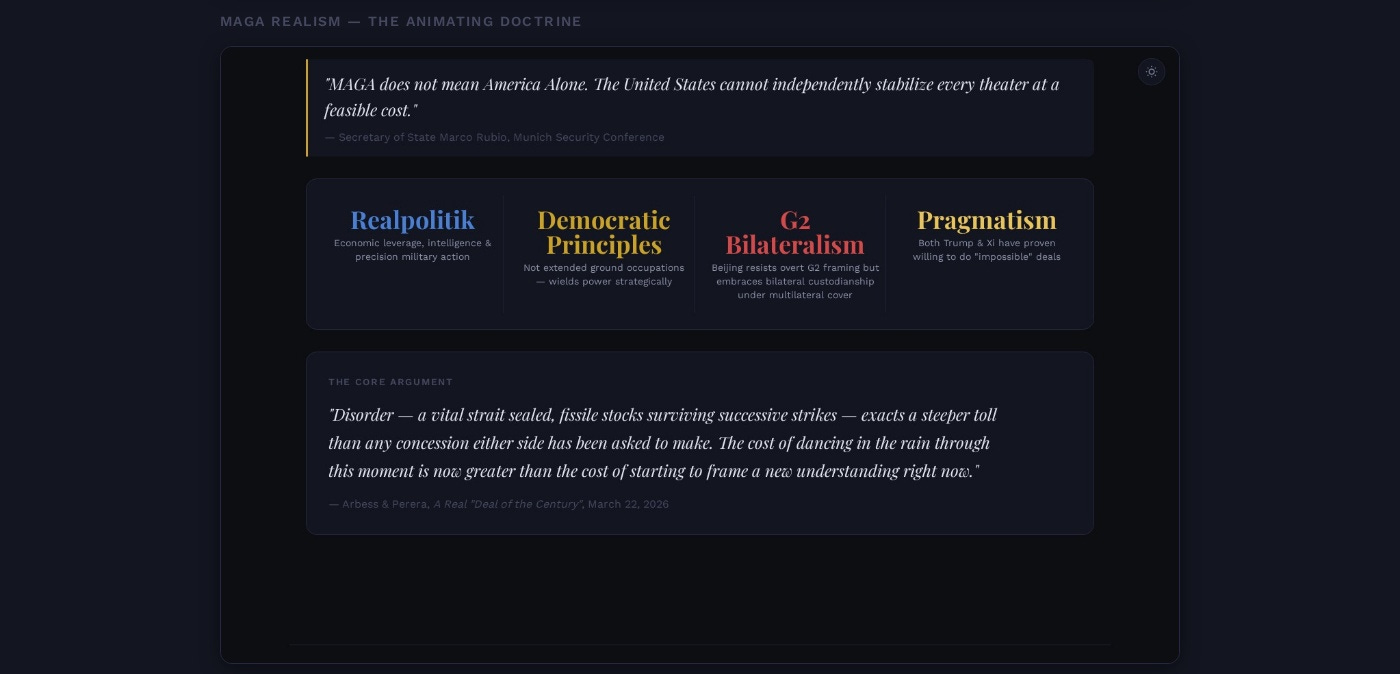
These meetings could map a true Deal of the Century: joint enforcement of maritime security; reciprocal access to critical resources; and coordinated management of nuclear and other emerging existential security threats. It could become a pragmatic, great-power-led alternative to the eroding institutions of the post-second world war order. The animating doctrine for USA is MAGA Realism, a fusion of realpolitik and democratic principles that wields economic leverage, intelligence, and precision military action rather than extended ground occupations. It is a doctrine that knows it needs partners.
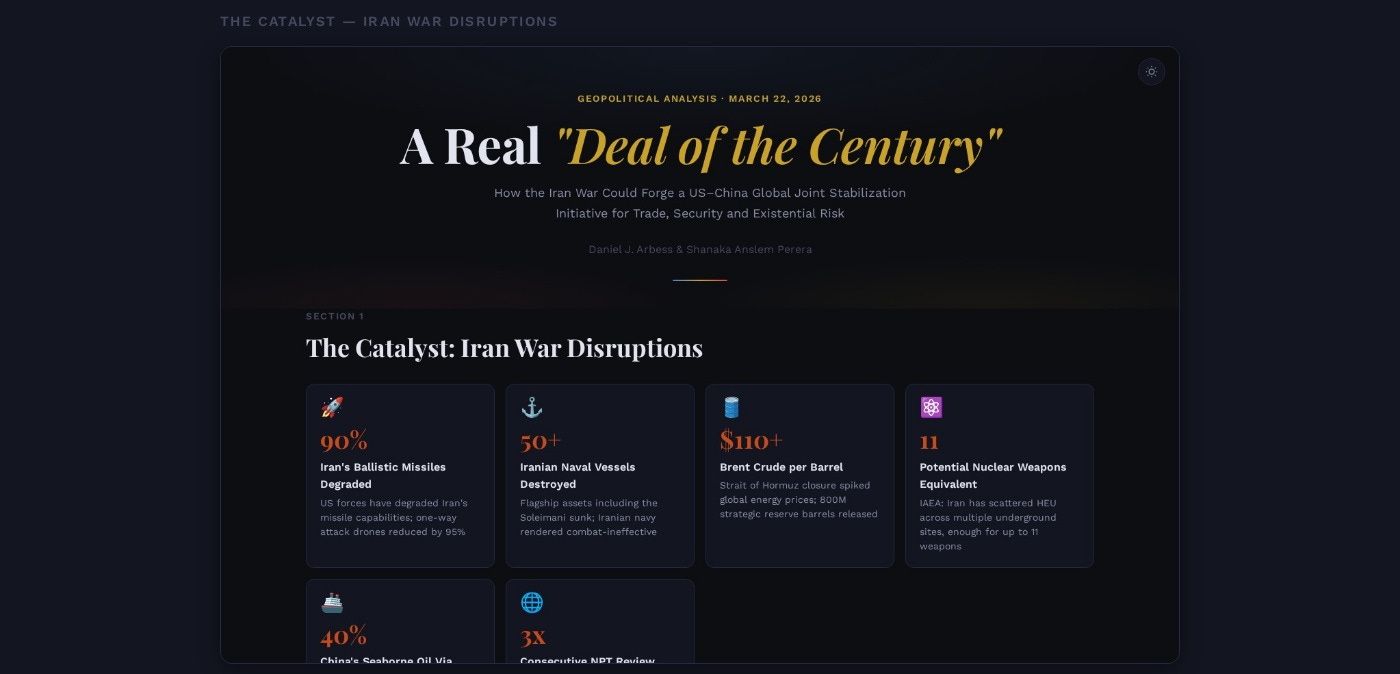
First, the Iran crisis itself: Pete Hegseth, secretary of war, has distilled victory into nine words: eliminate ballistic missiles, destroy the navy, and no nukes. Significant strides have been made. US forces have degraded Iran’s missile capabilities by 90 per cent and one-way attack drones by 95 per cent. The Iranian navy lies crippled, with over 50 vessels destroyed and flagship assets including the Soleimani sunk. Kharg Island’s defenses have been neutralized, leaving the energy storage and shipping infrastructure intact — for now.
It’s securing Iran’s nuclear materials that remains the primary imperative. IAEA assesses that Iran has scattered across multiple underground sites enough highly enriched uranium for up to 11 weapons. This requires special forces access, contingent on first neutralizing IRGC units at those locations and stemming reinforcements. China shares this imperative. Unchecked proliferation would unsettle the region, imperil Beijing’s vital energy routes, and risk a cascade no major power can afford to tolerate.
Meanwhile, Iran’s closure of the Strait of Hormuz has made the economic stakes concrete for both powers and the global economy. Tanker traffic has plummeted, Brent crude has closed above $110 a barrel; the International Energy Agency has released 400 million barrels from strategic reserves, and the United States has waived sanctions on another 140 million barrels of seaborne Iranian oil. China, dependent on the strait for 40 per cent of its seaborne oil and 30 per cent of its liquefied natural gas, has continued Iranian imports amid the blockade. The US Navy can escort limited convoys and has called for other nations to help. But enduring stability demands more: shared intelligence, agreed rules of engagement, and multilateral arrangements extending from Hormuz through the Malacca Strait to the South China Sea.
Controlling nuclear proliferation demands the same collaborative logic. Airstrikes can retard a rogue nuclear program but they cannot eradicate one. Verification and a durable framework are the only answers. The NPT’s Article VI binds both Washington and Beijing, along with other nuclear powers, to pursue disarmament in good faith, yet the treaty is all but left for dead: New START lapsed without renewal, leaving the world’s largest arsenals unconstrained, while China has declined trilateral talks amid its own modernization. The NPT Review Conference convenes after three consecutive failures to achieve anything at all. The Biological Weapons Convention lacks any verification protocol. And the IAEA has had no access to any of Iran’s declared enrichment facilities in almost a year.
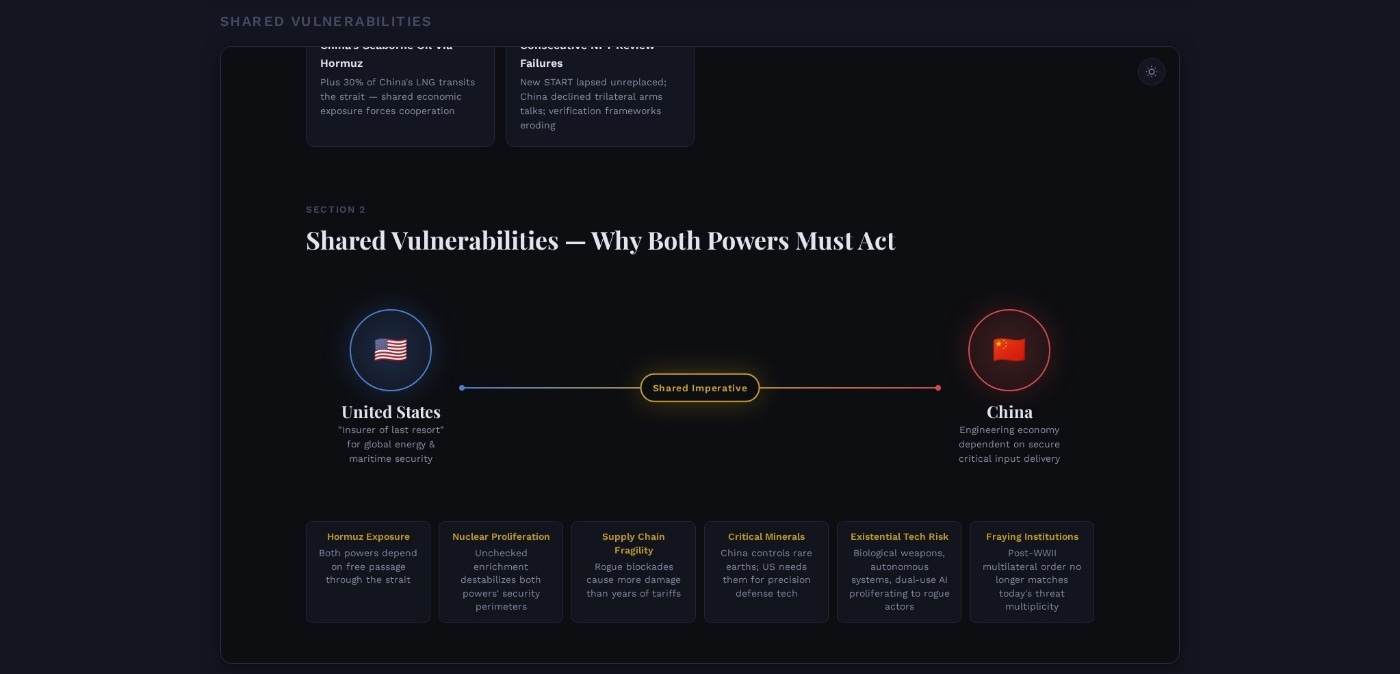
The treaties of the last century were created for one category of weapon in a bipolar stand-off of “mutual assured destruction”. They no longer match the multiplicity and speed of today’s risks, where biological engineering, autonomous systems and dual-use AI are cascading exponentially toward rogue nations and non-state players. Meanwhile, the industrial base needed to sustain effective defense operations against these threats depends on supply chains being disrupted by these same rogue forces — and in some cases the great powers themselves: China controls rare earth capacities that shape essential components of US precision defense technologies.
As Secretary of State Rubio said at the recent Munich Security Conference, MAGA “America First” does not mean America Alone. The United States cannot independently stabilize every theater at a feasible cost. It has been forced to become the insurer of last resort for global energy maritime security. Nor can China’s engineering economy function reliably without reliable delivery of critical inputs.
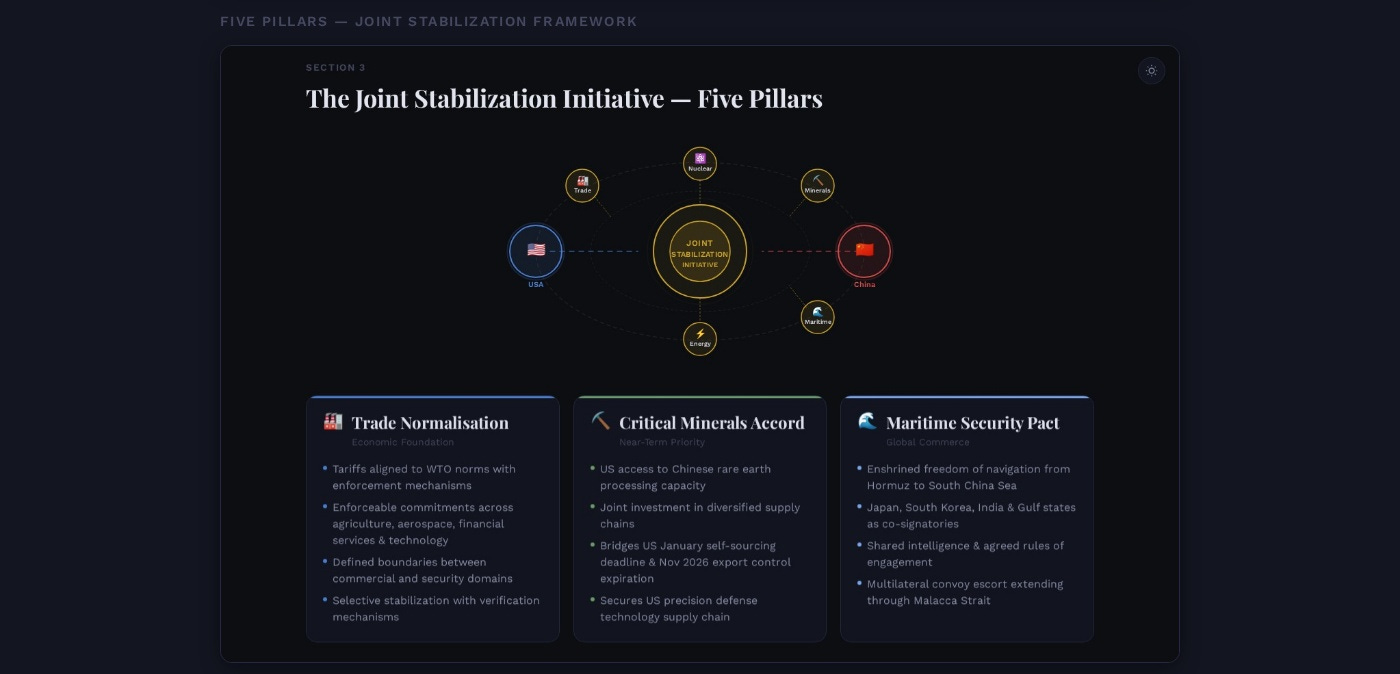
A real Deal of the Century would open with trade normalization — tariffs aligned to WTO norms, enforceable commitments across agriculture, aerospace, financial services, and technology. A critical minerals accord would secure US access to Chinese refining in exchange for collaborative investment in diversified extraction. A maritime security pact would enshrine freedom of navigation with Japan, South Korea, India, and the Gulf states as co-signatories. The nuclear framework would establish a moratorium on fissile material production for weapons, bring China into trilateral arms negotiations with Russia, and concert action on both Iranian stocks and North Korean denuclearization. Energy ties would expand US LNG exports to China, seed joint clean-technology ventures, and harmonize strategic reserves against future shocks.
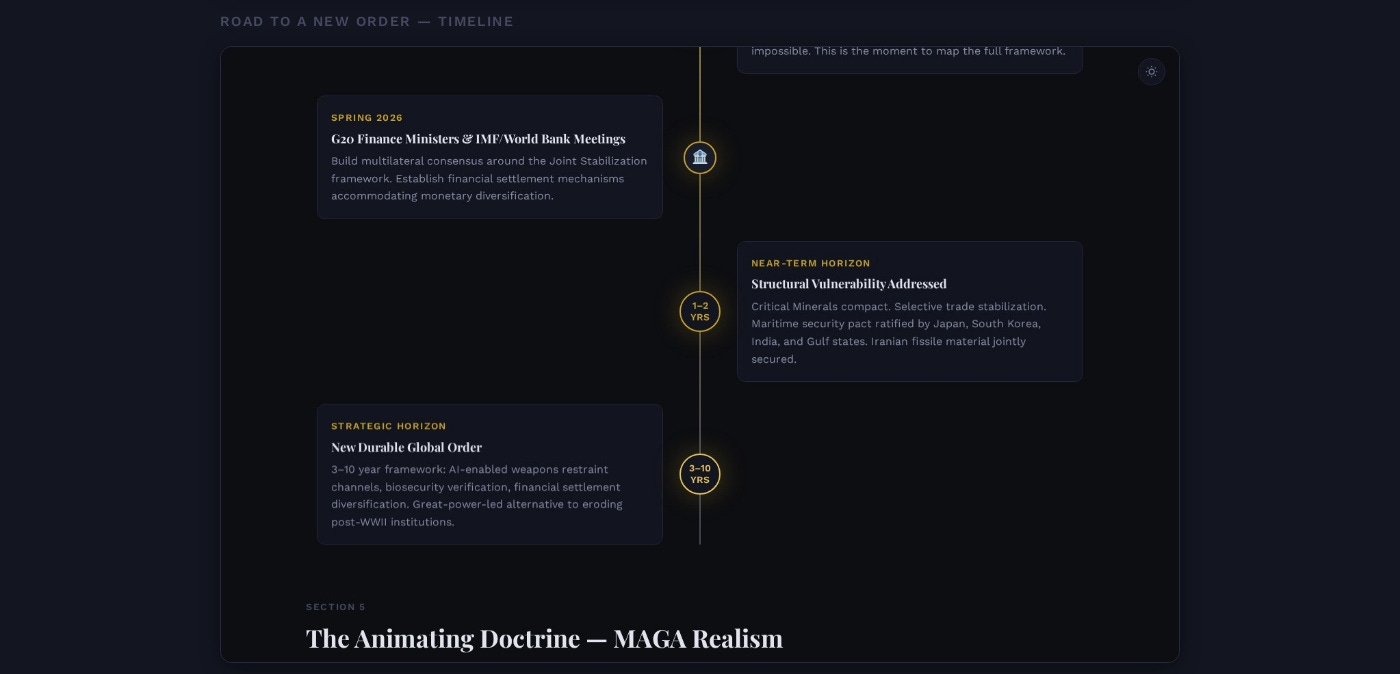
The near-term horizon, measured in one to two years, addresses structural vulnerability. A Critical Minerals compact would exchange guaranteed American access to Chinese rare earth processing for joint investment in diversified supply chains, buying time for domestic capacity to reach scale before the January self-imposed US deadline for sourcing from China, and the November 2026 expiration of Chinese export control suspensions. Selective trade stabilization would proceed with enforcement mechanisms and defined boundaries between commercial and security domains. Both nations would issue a joint statement at or before the NPT Review Conference recommitting to Article VI obligations and establishing concrete steps for recovering and securing Iran’s dispersed fissile material.
The strategic horizon, measured in three to ten years, extends to restraint channels on AI-enabled weapons systems, biosecurity verification, and financial settlement mechanisms that accommodate monetary diversification without destabilizing the systems on which both sides depend. Each ring can be structured for verification, bounded in scope, and justified independently of the others.
Skeptics will invoke deep-seated mistrust and inexorable rivalry. Fair enough, in light of the last fifteen years’ narratives on both sides, starting with China’s taking the benefit of WTO membership without the returning the commitments to limit subsidies and IP protection. And the the bilateral relationship carries the huge burden of misunderstanding about Taiwan’s status. Mao told Kissinger and Nixon that Taiwan would be unified with China a hundred years after the communist revolution in 1949. Nixon and Kissinger knew they personally would be long gone by then, so they agreed a Taiwan policy of “strategic ambiguity” until then—classic can-kicking, a serious bug of democratic systems facing long cycle authoritarian counterparts like the Chinese Communist Party (CCP) and, more menacingly, the Muslim Brotherhood.
But the Iran war has introduced a new variable. A rogue regime’s blockade has inflicted more economic damage in weeks than years of tariffs ever could. The lesson is not that Washington and Beijing trust each other, and the framework proposed here does not require them to. It requires only that each side recognize what disorder now costs. Fissile stocks surviving successive strikes, a vital strait sealed, global reserves drained are the invoice for inaction being paid by both nations, the Gulf allies, Israel and maybe yet Europe. Count on the CCP always to do what keeps their people quiet and themselves in power.
China’s foreign minister Wang Yi has called for managing divergences and clearing extraneous obstacles — Beijing’s preferred idiom for exactly the kind of bilateral custodianship this moment demands. Both Trump and Xi have demonstrated a pragmatic willingness to do deals their predecessors considered impossible. Their summit delay has offered new preparation time. The NPT conference and Spring G20 Finance Ministers and IMF/World Bank Annual Meetings would be appropriately used to build consensus.
This is a rare moment in history when great-power rivalry and shared existential threat converge to make cooperation the obvious path. Both sides recognize it. Now they should act before the price goes still higher.
Daniel J. Arbess is founder and chief executive of Xerion Investments and Lifetime Member of the Council on Foreign Relations. Shanaka Anslem Perera is an independent policy analyst widely followed on social media.
A Visual Framework—The Joint Stablization Initiative