Cold War camaraderie: Why US refuses to take Pak to task
- August 27, 2025
- Posted by: Lt Gen Syed Ata Hasnain (Retd)
- Categories: Pakistan, US
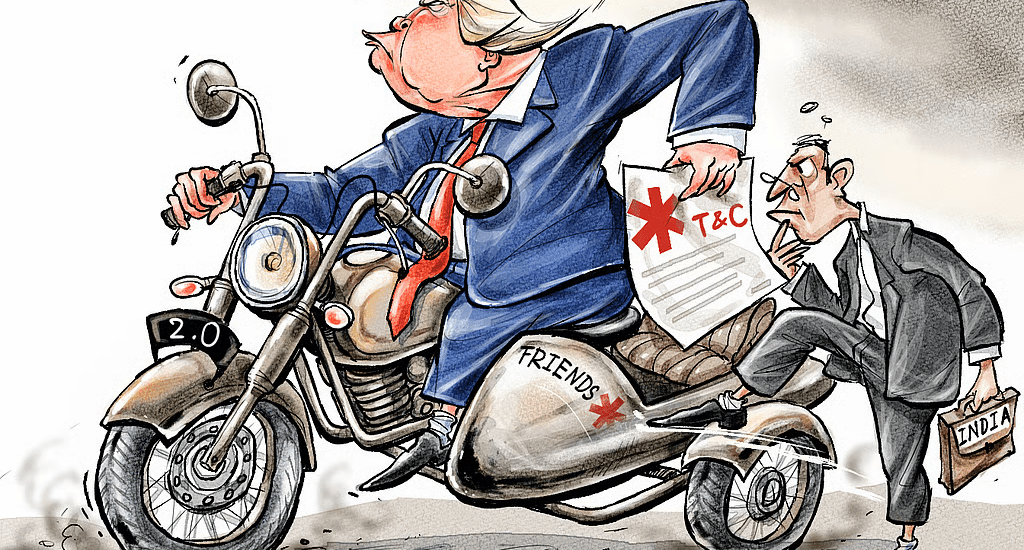
The camaraderie between American and Pakistani militaries is a Cold War legacy that gets in the way of India-US relations. But a genuine India-US partnership is a necessity
Lt Gen Syed Ata Hasnain (retd)
It was in 1991 that India-US relations began to acquire a strategic shape. With the Cold War concluded and the Soviet Union reduced to a diminished Russia, the US found itself in an unfamiliar role—as a lone superpower with global responsibilities. It recognised the dangers of complacency in victory and quickly began pivoting from its Atlantic preoccupations to the Asia Pacific, anticipating a new set of challengers.
The growing rise of China, while facilitated in earlier decades by the US itself, had begun to look less like an opportunity and more like a coming storm. India, geographically positioned next to China, democratically stable and increasingly open to global markets, became a natural component of this new architecture—a potential US partner.
Yet, for much of its early strategic phase, the India-US relationship remained cautiously transactional. Military-to-military ties grew at a measured pace, beginning with the Malabar exercises in 1992. Somehow, the trust deficit remained a Cold War legacy. The 1998 Pokhran nuclear tests were a shock to Washington and created an immediate rift. But this proved temporary. President George W Bush’s outreach, culminating in the landmark civil nuclear deal, and external affairs minister Pranab Mukherjee’s 2005 speech at RAND Corporation marked a turning point. India, at that point, became a more serious US partner.
The devil in the relationship remained Pakistan. The US equivocation on Pakistan’s role in cross-border terrorism has been one of the most vexing elements of this evolving relationship. Despite overwhelming evidence of Pakistan’s nurturing of terror networks, Washington has not held Islamabad to account. It has always had the leverage—economic, diplomatic and military—but rarely used it. The oft-cited reason is strategic: an overstated fear of pushing Pakistan further into China’s embrace. In reality, it is also an emotional and historical inertia rooted in the Cold War, SEATO, CENTO and years of military camaraderie.
Advertisement
This is not speculative. I speak from personal experience, having undergone a military course in the US with officers from the Pakistan Army in attendance, too. The bond between the American and Pakistani militaries is real, deep and difficult to dislodge. They understand each other and work together with comfort. One could argue that part of this stems from shared Cold War experiences or joint operations like the one in Somalia in 1994, when Pakistani troops defended the US embassy in Mogadishu. What is rarely acknowledged, however, is that the eventual securing of the embassy was only possible because a hurriedly assembled Indian half-squadron of tanks relieved the Pakistani armour at the Mogadishu airfield. That moment of quiet Indian support remains under-acknowledged.
The structural flaw in India-US relations has always been that it remains seen through a binary lens—India and Pakistan—as if American favour must always be distributed evenly. For India-US relations to be truly transformational, they must escape this dyad. India and the US have too much at stake in technology, commerce, maritime security, climate and global governance to be held hostage to the remnants of a 20th-century rivalry.
This brings us to the present dynamics under Donald Trump. India had initially expected Trump to be both pragmatic and sympathetic to its concerns. His public embrace of the Indo-Pacific construct, his emphasis on strong borders and sovereignty, and his apparent frustration with Pakistan’s duplicity seemed like the perfect alignment.
Indeed, during his first term, Trump’s approach was more empathetic. Despite the shadow of the Countering America’s Adversaries Through Sanctions Act, the US refrained from sanctioning India over the S400 missile deal with Russia. Similarly, there was leniency on oil imports from Russia, even as global pressure mounted. External Affairs Minister S Jaishankar has made India’s position abundantly clear—that the government’s primary responsibility is ensuring energy security for its citizens and national interest would guide decision-making.
Advertisement
The tone of accommodation seems to have changed. Trump’s recent frustration appears to stem from India’s firm stance on key issues, most notably Operation Sindoor. The Trump camp’s insinuation that the India-Pakistan ceasefire was the result of his persuasion was swiftly and correctly rejected by India. This assertion—factually incorrect and diplomatically presumptuous—cut across the grain of Indian strategic autonomy. India had initiated Operation Sindoor in response to the Pahalgam massacre and concluded it on its own terms. It did not, and would not, allow external mediation to shape decisions about national security.
That rejection of Trump’s narrative seems to have left a mark. It is no coincidence that in the weeks that followed, Washington signalled a shift—through renewed tariffs, subtle warnings of sanctions, and even gestures like the highly publicised lunch involving Pakistan’s army chief General Asim Munir. There is also an emerging narrative that Pakistan has permitted the US to use its airspace and, possibly, bases in any contingency involving Iran. If that assessment holds, Trump may now be leaning on Islamabad once more, seeing more compliance there than from India. But such a perception is strategically flawed.
India is not a nation to be managed through coercion or conditional friendship. Its rise on the global stage is not dependent on American affirmation, even though alignment with the US remains desirable and necessary in many spheres. The US must recognise that a truly capable partner like India will, and must, act independently. The more Washington respects that, the stronger the partnership will be.
Trump’s transactionalism—his need to claim credit, to convert strategic engagement into personal legacy—runs contrary to India’s centuries-tested approach of silent perseverance and dignified resistance. It has seen many like it in the past— from the cold estrangement after Pokhran to the sanctions of the early 2000s. What matters now is that India holds its ground, continues dialogue, and keeps faith in the long arc of its diplomatic strategy.
The friendship between India and the US is one of shared opportunity. But to reach its full potential, it must shed the baggage of older assumptions. A future built on equality, respect, and genuine understanding is not utopian—it is necessary. But it will not arrive through threats, tariffs, or credit claims. It will arrive when the conditions of friendship are taken as a strategic necessity without conditionalities.
Lt Gen Syed Ata Hasnain (retd) | Former Commander, Srinagar-based 15 Corps; Chancellor, Central University of Kashmir
(Views are personal)
(atahasnain@gmail.com)