Pakistan’s ASEAN Ambitions: Limits of Engagement and Prospects for Partnership
- August 22, 2025
- Posted by: Ambassador Gurjit Singh
- Categories: ASEAN & ARF, Pakistan
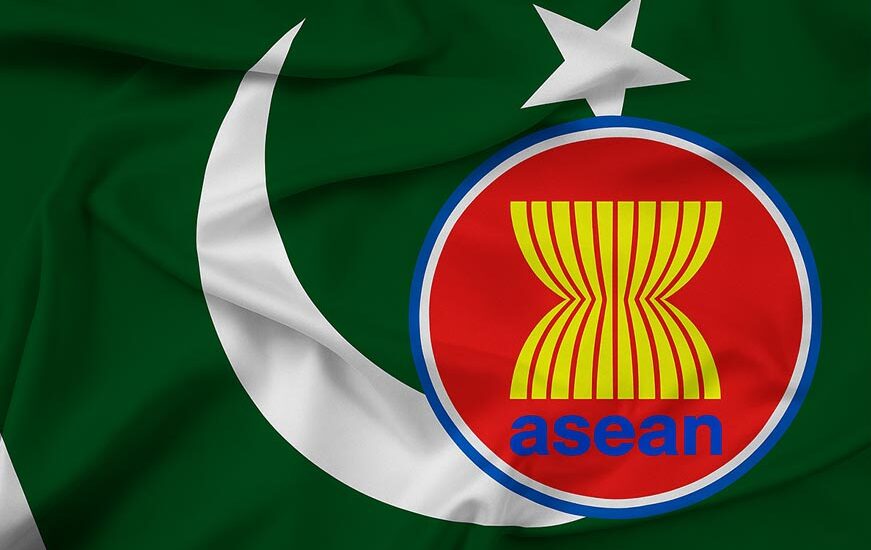
Pakistan’s bid for ASEAN upgrade faces familiar roadblocks—economic limits, weak linkages, and geopolitical distrust stall Full Dialogue ambitions.
Pakistan has long aspired to play a more significant role in Southeast Asia. Its ambition to upgrade its relationship with the Association of Southeast Asian Nations (ASEAN) from a Sectoral Dialogue Partner (SDP) to a Full Dialogue Partner (FDP) status has been on the agenda for over three decades. Although Pakistan became an SDP in 1993, its first meeting was held in 1997. Pakistan joined the ASEAN Regional Forum (ARF) in 2004. It has struggled to move beyond symbolic engagement. Recent efforts to rekindle its ASEAN outreach reflect Islamabad’s desire to assert a more active role in the Indo-Pacific. Yet, structural issues, limited economic integration, and strategic doubts continue to block Pakistan’s path to a deeper partnership.
Pakistan has also expressed its willingness to join the ASEAN-led frameworks such as the East Asia Summit and the ASEAN Defence Ministers’ Meeting Plus (ADMM-Plus).
Over the past few years, Pakistan has intensified its diplomatic efforts toward ASEAN. Officials have visited key capitals in Southeast Asia, hosted trade delegations, and rearticulated Pakistan’s ‘Vision East Asia’ policy. These steps constitute a broader effort to diversify foreign policy beyond its traditional strategic zones—South Asia, the Middle East, and China. Pakistan has also expressed its willingness to join the ASEAN-led frameworks such as the East Asia Summit and the ASEAN Defence Ministers’ Meeting Plus (ADMM-Plus). These remain closed, as they are limited institutions that seek to avoid dilution; nonetheless, these overtures signal a shift in Islamabad’s geopolitical thinking and its recognition of Southeast Asia’s rising importance in global politics.
Despite these moves, ASEAN remains hesitant to upgrade Pakistan’s status. One of the most persistent problems has been inconsistency in Pakistan’s policy approach. ASEAN values long-term, predictable partnerships built on trust and continuity. In contrast, Pakistan’s engagement with ASEAN has been sporadic, often driven by changes in domestic leadership. Without a consistent institutional policy towards Southeast Asia, Islamabad has failed to build the kind of sustained rapport that ASEAN expects.
Another significant hurdle is economic. ASEAN is fundamentally a market-driven organisation. While Pakistan imports heavily from ASEAN, its exports to the region remain small and unbalanced. Moreover, foreign direct investment (FDI) from ASEAN into Pakistan is limited. Unlike India—which has built economic stakes across ASEAN and signed free trade agreements (FTAs)—Pakistan has not concluded any meaningful trade arrangements with the bloc. The absence of concrete economic integration makes it difficult for ASEAN to justify a stronger partnership.
Unlike India—which has built economic stakes across ASEAN and signed free trade agreements (FTAs)—Pakistan has not concluded any meaningful trade arrangements with the bloc.
Furthermore, cultural and people-to-people linkages also remain weak. In contrast to the strong educational, diaspora, and tourism links that countries such as India, Japan, and South Korea have cultivated with Southeast Asia, Pakistan has few institutional or civil society-level bridges with the region. Academic exchangeacs are minimal, public diplomacy is underutilised, and cultural cooperation is rare. This lack of connection at the societal level limits Pakistan’s ability to build goodwill in ASEAN member states.
Strategically, while Pakistan has security cooperation with some ASEAN countries—especially in areas including military training and counter-terrorism—it is not a visible or central player in regional security dialogues. ASEAN has deep concerns about maritime security, cyber threats, and regional balance in the South China Sea, areas where Pakistan’s contributions have been marginal. Moreover, Pakistan’s close alignment with China can make some ASEAN members cautious, particularly those wary of Chinese influence.
There are also broader perception challenges. Some ASEAN states view Pakistan through a security-centric lens, with concerns about extremism, internal stability, and its tense relations with India. ASEAN’s preference for neutrality and regional peace means that internal South Asian rivalries are not welcomed in its forums. Pakistan’s long-standing friction with India and occasional framing of ASEAN outreach in anti-India terms creates discomfort among members who avoid taking sides in South Asian disputes.
Despite these obstacles, Pakistan seeks opportunities to recalibrate its ASEAN strategy. A study by the Islamabad Policy Research Institute—which appeared self-critical—was undertaken in 2022. The study suggested that Pakistan should establish institutional continuity in its engagement, possibly through a dedicated ASEAN division within the country’s Foreign Ministry (much like India’s ASEAN-ML Division) that outlasts political cycles. Second, Islamabad should enhance economic diplomacy by promoting trade agreements, encouraging ASEAN investments in Pakistani special economic zones, and integrating its economy with ASEAN supply chains.
Third, Pakistan could amplify people-to-people ties through scholarships, cultural centres, and academic links, building long-term trust. Reframing security cooperation around non-traditional threats and joint Humanitarian Assistance and Disaster Relief (HADR) exercises aligns with ASEAN’s priorities, mirroring India’s successful approach to regional engagement.
Pakistan lacks a diplomatic narrative grounded in mutual benefit rather than regional rivalry. Instead of highlighting shared interests—such as sustainable development, climate resilience, and digital transformation—it has often framed ASEAN either as a counterbalance to India or as part of its China-centric strategy, exposing its own structural limitations.
Islamabad should enhance economic diplomacy by promoting trade agreements, encouraging ASEAN investments in Pakistani special economic zones, and integrating its economy with ASEAN supply chains.
ASEAN’s cautious and consensus-based nature implies that only a sustained, multi-dimensional, and constructive engagement can earn Pakistan the status it seeks. The road to Full Dialogue Partnership is long. However, if Pakistan takes consistent and credible steps to align with ASEAN’s values and vision, the study concludes, it may eventually achieve the status it seeks.
Pakistan’s Push for Full Dialogue Partner Status in ASEAN Gains Traction?
Pakistan’s long-standing relationship with ASEAN is perhaps attracting attention as Islamabad intensifies its efforts to become a full dialogue partner. Pakistani High Commissioner to Malaysia Syed Ahsan Raza Shah—addressing a recent press briefing—reiterated Pakistan’s diplomatic commitment to Southeast Asia and underscored the value of deeper engagement with ASEAN. This renewed effort seeks to build on a relationship established in 1993, when Pakistan became ASEAN’s first sectoral dialogue partner. However, it is not Pakistan’s Ambassador to ASEAN in Jakarta making this statement, but its High Commissioner to Malaysia.
The High Commissioner described ASEAN as a “vital platform for regional peace and stability,” highlighting Islamabad’s desire to expand cooperation across a wide spectrum—including economic development, security collaboration, cultural exchange, and environmental sustainability. He noted that discussions on Pakistan’s upgraded status had already taken place at the highest political levels, including a recent exchange between Pakistan’s Prime Minister (PM) Shehbaz Sharif and Malaysian PM Datuk Seri Anwar Ibrahim.
Malaysia is a prominent supporter of Pakistan within ASEAN. It is now leveraging its Chairmanship to bolster Pakistani ambitions. Anwar publicly voiced his support as early as October 2024 and reaffirmed it on 7 June 2025, stating that the matter would be brought up for deliberation at the upcoming ASEAN Leaders’ Summit. “It will be brought up for discussion at the ASEAN leaders’ conference,” Anwar said after performing Aidiladha prayers in Putrajaya. The Malaysian endorsement is particularly significant given that the rotating ASEAN Chairmanship is with Malaysia in 2025—a development that Pakistan seeks to utilise.
Over the past three decades, ASEAN-Pakistan ties have grown through institutional and practical cooperation in trade, investment, tourism, and technology. Yet, trade volumes remain modest compared to ASEAN’s major partners, such as China and India. Nevertheless, 2022 recorded peak trade levels, driven by agreements such as the Pakistan–Malaysia FTA and the Pakistan–Indonesia Preferential Trade Agreement.
The ASEAN-Pakistan Joint Sectoral Cooperation Committee (AP-JSCC) has become a pivotal mechanism in evaluating progress and defining new avenues for cooperation.
Pakistan is seeking to increase its involvement in the ASEAN Regional Forum (ARF), highlighting its commitment to broader regional security dynamics. It is the only ASEAN-centric body Pakistan is a member of, and the ARF’s own vitality is in doubt. More recently, the ASEAN-Pakistan Joint Sectoral Cooperation Committee (AP-JSCC) has become a pivotal mechanism in evaluating progress and defining new avenues for cooperation. At the seventh and eighth AP-JSCC meetings—held in 2023 and 2025, respectively—delegates from both sides agreed to revitalise their partnership through practical cooperation activities aimed at delivering tangible outcomes.
The 2023 Business Conference, organised under this framework, facilitated over 400 Business-to-Business (B2B) meetings and generated real economic impact, including deals between Micro, Small, and Medium Enterprises (MSMEs) in ASEAN countries and Pakistan. Building on this momentum, both sides agreed to extend the Practical Cooperation Areas (PCA) framework from 2019–2021 to a more expansive and ambitious PCA 2024–2028.
The 2025 AP-JSCC meeting, co-chaired by the Deputy Secretary-General of ASEAN for the Socio-Cultural Community and Pakistan’s Ambassador to ASEAN, reaffirmed this commitment. The meeting took stock of progress made in trade and investment, science and technology, media cooperation, and human resource development. It also identified opportunities for collaboration under ASEAN’s major strategic documents, including the ASEAN Outlook on the Indo-Pacific (AOIP), the Master Plan on ASEAN Connectivity 2025 (MPAC), and the Initiative for ASEAN Integration (IAI) Work Plan IV. ASEAN expects its Dialogue Partners (DPs) to contribute meaningfully to its plans and development objectives—an area where Pakistan currently lacks sufficient capacity.
Under Malaysian ASEAN Chairmanship in 2025, support for Pakistan’s ambitions for full dialogue partner status has flickered, but a breakthrough is unlikely. The moratorium on accepting new DPs, which has long delayed Islamabad’s request, remains a technical hurdle. Since 1996, no new Dialogue Partners had been admitted until the United Kingdom (UK), post-Brexit, persuaded ASEAN in 2021 to grant it DP status, similar to the European Union (EU). While the UK succeeded, Pakistan has been unable to convince ASEAN that it deserves the same status simply because India is already a Dialogue Partner.
Other ASEAN countries that will assume the chairmanship, such as the Philippines in 2026, Singapore in 2027, Thailand in 2028, and Vietnam in 2029, do not have an interest in either expansion or Pakistan’s candidacy.
Pakistan and Malaysia used their bilateral warmth to advance the DP idea. It gives Pakistani diplomacy something to show, while Malaysia shows their brotherhood, knowing full well that ASEAN lacks a consensus on admitting new DPs. The moratorium remains in place, and Malaysia’s Chairmanship will conclude in 2025, not returning until 2035. Other ASEAN countries that will assume the chairmanship, such as the Philippines in 2026, Singapore in 2027, Thailand in 2028, and Vietnam in 2029, do not have an interest in either expansion or Pakistan’s candidacy. Some of these countries are known to veto Pakistan’s bid consistently.
Whether or not ASEAN lifts its moratorium soon, the strengthening of practical ties across all three pillars of the ASEAN Community is now going through different formats, as with the Gulf Cooperation Council and other European development partners, all of whom can contribute to ASEAN. Unless ASEAN sees comparable value in Pakistan, it is unlikely to engage with it institutionally beyond the Practical Cooperation Areas (PCA).