The Saga of Pakistani Propaganda and Not So Mighty Chinese Fighter J-10C
- June 19, 2025
- Posted by: admin
- Categories: India, Pakistan
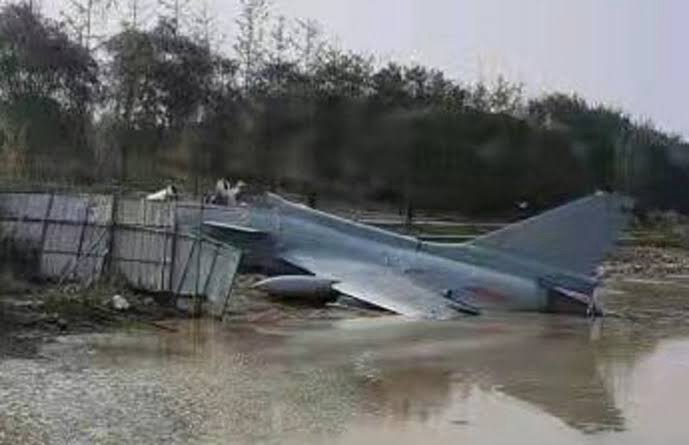
Crashed J-10C
On the night of May 6-7, 2025, India conducted attacks on terrorist hideouts located in Pakistan and Pakistan-Occupied Jammu and Kashmir (POJK). India successfully targeted nine terrorist camps during this operation. Over 120 military aircraft from both sides faced each other, but notably, no aircraft crossed the international border or the Line of Control (LOC).
The following day proved to be quite interesting, as Pakistan launched a propaganda campaign. Pakistani Prime Minister Shehbaz Sharif, on record, stated that the Pakistan Air Force (PAF) had shot down five Indian Air Force (IAF) fighters, claiming that three of these were Rafale fighter jets from the French company Dassault. Air Marshal Aurangzeb, the Director General of Public Relations for the PAF, presented a multimedia briefing that resembled a project from a 10th-grade student. Using a map with superimposed fighter jets, he convinced local journalists that this was the real situation, asserting that the PAF had decisively defeated the IAF.
This was followed by a barrage of paid articles and interviews in international publications and on TV channels. It appeared that many media outlets were eager to validate the narratives pushed by the Pakistani-Chinese alliance. The ‘X’ platform (formerly known as Twitter) played a significant role in amplifying this propaganda. Interestingly, ‘X’ had been banned in Pakistan since February 2025. However, on May 6, 2025—the day of the Indian attack—access to the social media platform was restored in Pakistan. This opened the floodgates for a prolonged saga of false narratives, fake videos, images, and propaganda.
The Hero That Wasn’t
The PAF public briefings referred to the J-10C as a high-tech fighter. Air Marshal A.K. Bharti, the Director General of Air Operations for the IAF, took a jab at this during a media briefing by mentioning that the IAF had shot down a couple of Pakistani high-tech fighters. While initial reports suggested that the PAF had ordered 25 J-10Cs, the current inventory indicates only 20 units.
China began developing the J-10 in the early 1980s to create a single-engine multirole fighter to replace the J-7 (the Chinese version of the MiG-21 Fishbed) for air defense, as well as the Q-5 Fantan ground-attack aircraft. The J-10 features a delta wing design with canard foreplanes, a chin-mounted engine intake, and fly-by-wire flight controls. The fighter incorporates many design elements from the Israeli Lavi fighter, although it is larger and heavier to accommodate a bigger Russian engine. At its best, the J-10C is comparable to the F-16 C/B Block 50 in terms of agility, carrying capacity, and size.
Many experts try to downplay the J-10’s heavy reliance on the discontinued Israeli Lavi fighter jet. However, in 2008, Jane’s reported that “Chengdu benefited from significant, direct input from Israel’s Lavi program – including access to the Israel Aircraft Industries (IAI) Lavi aircraft itself. This input included extensive design and performance modeling, wind-tunnel testing, and advanced aerodynamic design input. Chengdu officials at the highest levels stated that they had one of the IAI Lavi prototypes in their facilities.”